Industry
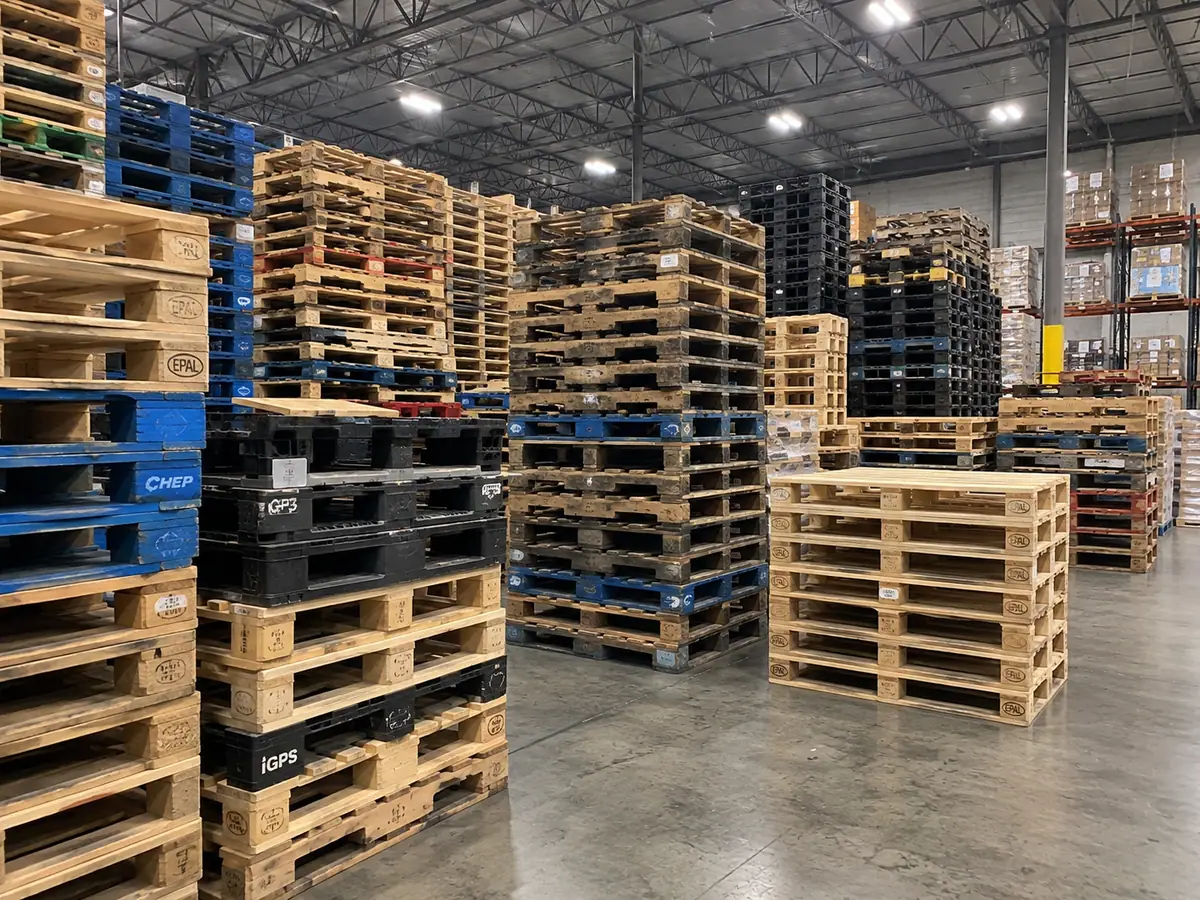
Pallets for manufacturing, where the same unit does forty laps a year.
Talk to us about manufacturing
Give us the quantity, the size and the ZIP. You'll get a written quote with the grade, the freight and the pickup window — not a sales call.
- Written quotes, usually inside one business day
- Loads from 100 pallets to full 53' trailers
- We buy as readily as we sell — tell us which way it flows
The last four per cent
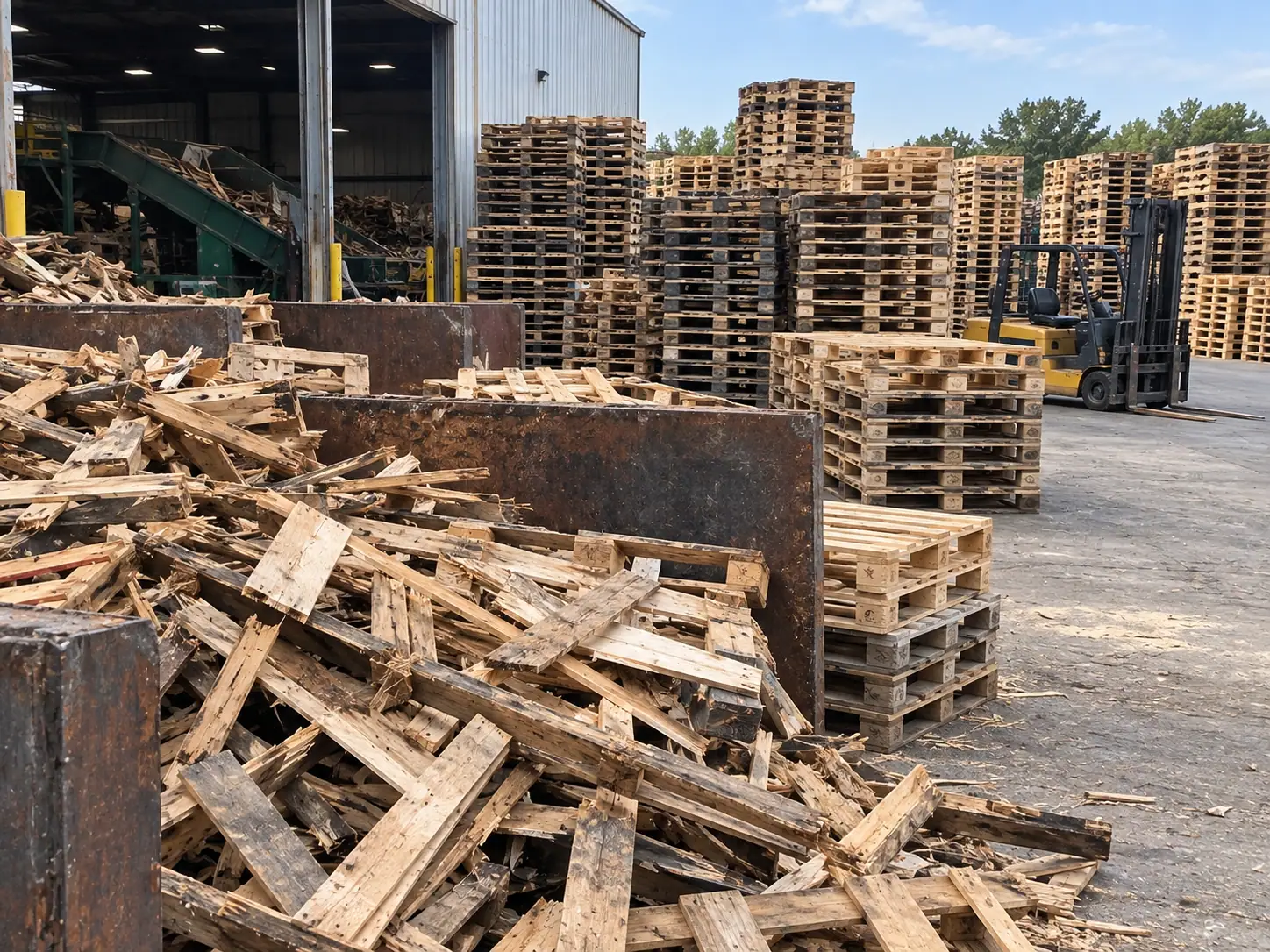
Everything the sort deck rejected, on its way to the grinder. It leaves as mulch, bedding and boiler fibre — not as landfill.
The internal fleet
Buy once, repair often, replace rarely
An outbound pallet is a consumable. An internal pallet is an asset, and it should be managed like one. The difference in economics is dramatic: a Grade A unit at $9.50 that gets repaired twice at $2.50 and does twenty-five cycles costs $0.58 per cycle. Replacing it every eight cycles instead costs $1.19.
Doing that properly requires two disciplines that most plants do not have: pulling damaged units out of circulation before they fail rather than after, and having somewhere for them to go that is not a skip. We supply both — a scheduled collection of damaged units and graded replacements on the same truck.
It also requires footprint discipline. A plant running three footprints because of three historical decisions is paying for three inventories, three racking exceptions and three purchasing lines. Consolidating is nearly always worth the transition cost.
Typical numbers
What a managed internal fleet looks like
40+
Cycles per unit per year
Typical for line-side and inter-plant movement.
$0.58
Cost per cycle, managed
Grade A stock with a repair loop.
$1.19
Cost per cycle, replace-only
Same stock, no repair programme.
3–4
Repairs before retirement
Before nail holes stop holding.
Questions
Manufacturing questions
Can you supply automotive 48×45?
Yes, though recycled cores in that footprint are scarce because they rarely leave the automotive network. See 48 × 45 automotive for the availability picture, and expect a longer lead time than a GMA.
What about automated handling?
AS/RS and high-speed conveyor lines need tighter tolerances than recycled stock reliably holds. For those applications we recommend new pallets built to a fixed spec, and we will say so rather than sell you jams.
Can you hold a buffer for us?
Yes, under a managed programme. It is the single most effective way to stop emergency spot purchases, which are usually the biggest line in a plant's pallet cost.
Do you do line-side delivery?
Delivery to a dock, yes. Inside the plant is your material handling, not ours, though for programme customers we will work to whatever staging arrangement your team wants.
Fleet economics
Cost per cycle, worked properly
| Approach | Unit cost | Cycles achieved | Repairs | Cost per cycle |
|---|---|---|---|---|
| Grade B, replace on failure | $6.50 | 2 – 3 | None | $2.17 – $3.25 |
| Grade A, replace on failure | $9.50 | 4 – 6 | None | $1.58 – $2.38 |
| Grade A with repair loop | $9.50 | 8 – 12 | 2 at $2.75 | $1.25 – $1.88 |
| New hardwood, replace only | $20.00 | 10 – 25 | None | $0.80 – $2.00 |
| New hardwood with repair loop | $20.00 | 18 – 35 | 3 at $2.75 | $0.81 – $1.57 |
| Any of the above at 8% loss/cycle | — | ≈ 12 max | — | Durability stops paying |
Line-side
What manufacturing asks of a pallet that distribution does not
- 01Dimensional consistencyLine-side racking, AGV lanes and automatic transfer stations are unforgiving about height and squareness. Recycled stock varies; new built to spec does not.
- 02Repairability rather than durabilityAn internal fleet is maintained, not replaced. What you want is a construction that repairs cleanly with recovered lumber, which favours hardwood and helical fasteners.
- 03MarkingStencilled fleet identification. Unmarked returnable pallets migrate out of the loop and never come back, and the loss rate is invisible until you count.
- 04Concentrated load capabilityCastings, gearsets and machined components are dense and land on small footprints. Published ratings assume uniform distribution and should be derated hard.
- 05Cleanliness for assembly areasSplinters and dust matter in electronics and painted-part handling in a way they do not in a warehouse. Ask for a clean sort, or use new.
Consolidating footprints
The most valuable project most plants never do
A plant running three footprints because of three historical decisions is paying for three inventories, three racking exceptions, three purchasing lines and three sets of handling assumptions. It is one of the most common and least examined costs in manufacturing.
The consolidation project is unglamorous: count what you actually run, work out which footprint the majority of your racking and handling already assumes, and convert everything else over a planned horizon rather than all at once.
Remanufacturing makes this much cheaper than it sounds. Orphan footprints can be cut down and rebuilt into a standard size rather than scrapped, typically at $3.50 to $6.00 a unit against $9.50 for replacement. It converts a write-off into a conversion.
The saving is rarely in the pallet price. It is in the exceptions that disappear — the racking bay that only takes one size, the purchasing line nobody remembers, the handling instruction that new operators get wrong.
Questions
More manufacturing questions
How do we stop losing returnable pallets?
Mark them, count them, and find out where they go. In our experience losses concentrate in three places: a customer who never returns them, a specific carrier or lane, and an uncounted accumulation somewhere on your own site. The third is more common than people expect.
Can you manage our fleet rather than sell us pallets?
Yes — collection of damaged units, repair with recovered lumber, and return of the same population. It is the arrangement most manufacturing customers end up with. See managed programs.
What tolerance can recycled stock actually hold?
Roughly ± ½″ on footprint and ± ¼″ on height for Grade A. Tighter than that needs sorting to a gauge, which we can do at a cost, or new stock built to specification.
Do you supply automotive footprints?
Yes, including 48×45. Recycled cores in that size are scarce because the footprint rarely leaves the automotive network, so expect batch availability and longer lead times than a GMA.
Can pallets be part of a lean programme?
They are usually a rich source of waste in the lean sense — overproduction of inventory, unnecessary transport, and defects that surface downstream. Counting touches per pallet is a good first exercise.