Service 06 — Building
Custom and new pallet builds, cut to your load rather than ours.
Get a build quoted
Give us the quantity, the size and the ZIP. You'll get a written quote with the grade, the freight and the pickup window — not a sales call.
- Written quotes, usually inside one business day
- Loads from 100 pallets to full 53' trailers
- We buy as readily as we sell — tell us which way it flows
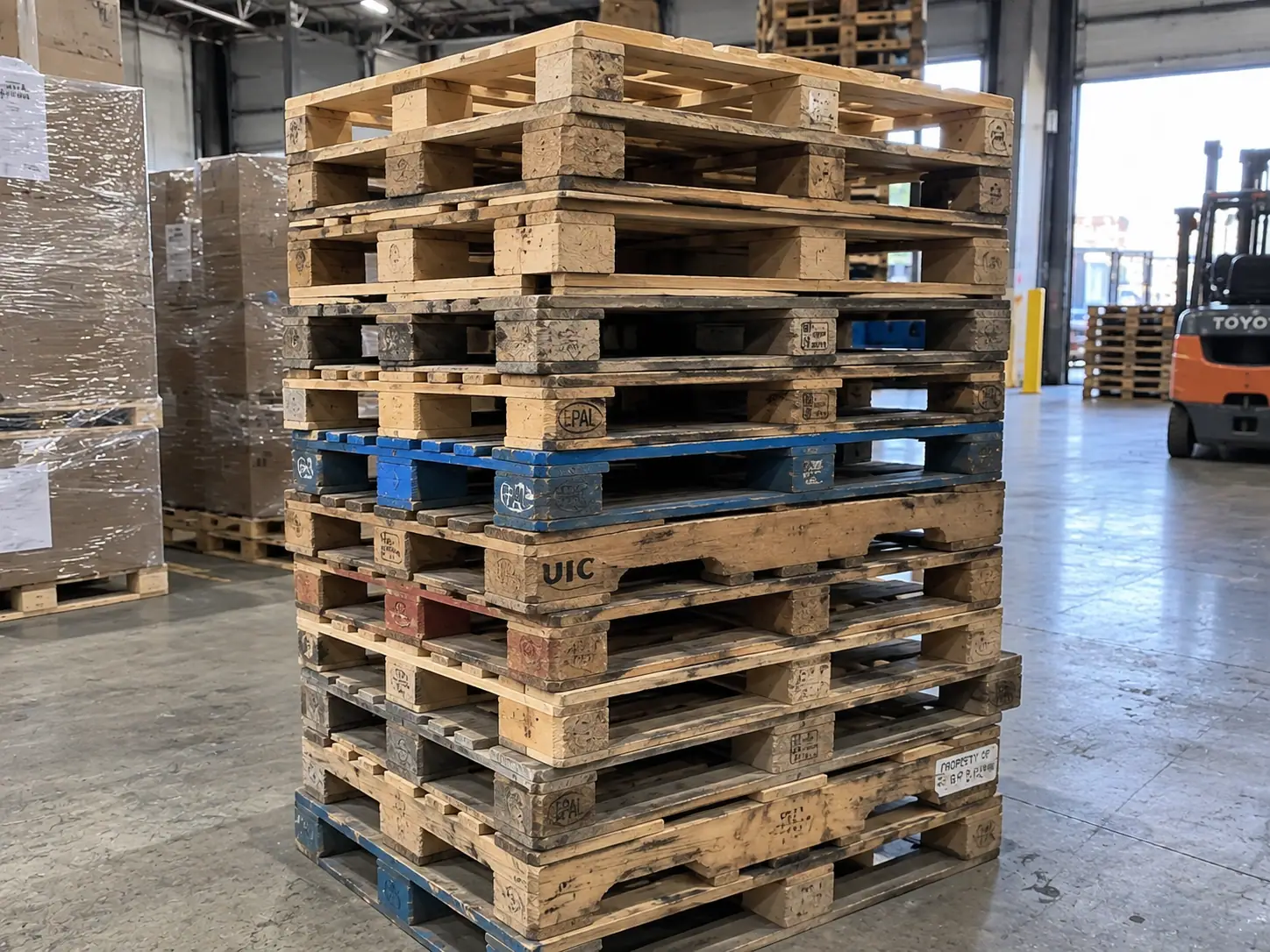
One stack
Fifteen high and square. A stack that leans is a stack somebody has to touch twice.
First, the argument against
Most custom pallets should have been standard ones
A custom footprint is a permanent tax. You cannot buy it on the spot market when you run short, your customers cannot return it into any pool, its resale value at end of life is a fraction of a GMA's, and every racking, conveyor and trailer decision downstream has to accommodate it forever.
Before we quote a custom build we will ask what happens if you use a 48×40 instead. Often the answer is 'we lose two cases per layer', and two cases per layer rarely justifies a decade of illiquidity. Sometimes, though, the answer is 'the product physically does not fit', and then a custom build is straightforwardly correct.
The full argument, including the cases where custom genuinely wins, is in the custom sizing guide.
When custom is right
Five loads that justify their own footprint
- 01Long or oversized productExtrusions, pipe, glass, sheet stock and machinery simply do not sit on a 48-inch deck. Overhang is the leading cause of edge damage in transit.
- 02Very heavy, concentrated loadsAbove about 4,000 lb, or with the weight concentrated on a small footprint, deck board spacing and stringer count matter more than footprint. This is engineering, not shopping.
- 03Automated handling with tight tolerancesAS/RS and shuttle systems specify overall height, bottom board placement and squareness to a few millimetres. Recycled stock cannot reliably hold that.
- 04Export cratingOne-way international shipments where the pallet is part of a crate. Build it once, build it right, heat-treat it and stamp it.
- 05Display and retail programsHalf and quarter pallets built to a retailer's planogram, often with a specific deck appearance because the shopper sees it.
What we can build
Stringer, block, skid, crate — and the awkward things in between.
We build two-way and four-way stringer pallets, block pallets with nine feet, two-runner skids, panel-deck units, collar-compatible bases and full export crates with cleated plywood.
Lumber is your choice: new hardwood or SPF for structural certainty, or reclaimed boards recovered from our own dismantling line where the spec allows — which typically drops the unit price by 20 to 35% and the embodied carbon by considerably more.
- Any footprint from 20×20 up to 96×48
- New hardwood, new SPF, or reclaimed recovered lumber
- Two-way, partial four-way notched, or full four-way block construction
- ISPM-15 heat treatment and marking on request
- Load testing to ISO 8611 through a partner lab where a spec requires it
- Prototype in 3–5 business days, production runs from 250 units
60 × 48 heavy build
How a build happens
From a photo of your load to a stack on your dock.
- Step 01
Tell us the load
Weight, dimensions, how it sits, where it goes, how it is handled and whether it racks. A photo of the product on its current pallet answers most of this in one go.
- Step 02
We propose a spec
Deck pattern, board thickness, stringer count and species, with a load rating and a price. Usually two options: the cheap one and the durable one.
- Step 03
Prototype
Three to five business days for a physical unit you can load and abuse before committing to a run.
- Step 04
Production
Runs from 250 units, typically two weeks. Repeat orders draw down from a held spec, so the second order takes days.
Questions
Custom build questions
What is the minimum order for a custom pallet?
250 units for a production run. Prototypes are quoted individually and we will build one or two so you can test properly.
Can you build to a load rating rather than a drawing?
Yes, and it is usually the better conversation. Tell us the weight, the load distribution and the handling — racked, stacked, conveyed, clamped — and we will design to it.
Is a new pallet ever cheaper than a recycled one?
Not per unit, but sometimes per cycle. If a new pallet survives eight internal loops and a recycled one survives four, the new pallet was cheaper. This is the entire argument in recycled vs new pallets.
Do you build with reclaimed lumber for structural pallets?
For most applications, yes — recovered hardwood deck boards are frequently stronger than the new SPF alternatives. For rated, engineered or automated-handling applications we specify new lumber, because the variability of recovered stock is not acceptable there.
Specification reference
The dimensions we build to
| Member | Light duty | Standard | Heavy duty | Governs |
|---|---|---|---|---|
| Top deck board | ½″ × 3½″ | 9/16″ × 3½″ | ¾″ × 5½″ | Deflection under concentrated load |
| Bottom deck board | ½″ × 3½″ | 9/16″ × 5½″ | ¾″ × 5½″ | Racked capacity, beam contact area |
| Stringer | 1⅜″ × 3″ | 1⅜″ × 3½″ | 1⅝″ × 3½″ | Bending — depth is cubed, so this dominates |
| Stringer count | 3 | 3 | 4 | Load distribution across the span |
| Notch | None (two-way) | 9″ × 1½″ | 9″ × 1½″ | Four-way access, at a cost in stringer strength |
| Fastener | Smooth shank | Helically threaded | Helically threaded, increased count | How long the unit stays square |
| Deck gap | ≤ 4″ | ≤ 3½″ | ≤ 2½″ | Whether small cases fall through |
| Chamfer | Optional | Bottom boards | Bottom boards | Whether a pallet jack rides up cleanly |
The build process
From photograph to production run.
- Step 01
Send the load, not the drawing
A photograph of your product on its current pallet with a tape measure in frame, plus a weight. That answers more questions than a specification sheet usually does.
Day zero.
- Step 02
We propose two specifications
The cheap one and the durable one, each with a load rating, a unit price and an honest note about where each will fail first. Usually one of them is a standard footprint and we will make that case.
Two to three business days.
- Step 03
Prototype
A physical unit you can load, rack, drop and abuse. We would rather you broke it now than in six months across a hundred thousand dollars of production stock.
Three to five business days.
- Step 04
Adjust and confirm
Almost every prototype produces one change. Usually deck gap, occasionally stringer depth after somebody racks it and does not like the deflection.
Whatever it takes.
- Step 05
Production run
From 250 units. The specification is held on file, so repeat orders draw down from it and take days rather than weeks.
About two weeks for a first run.
Before you specify
The five measurements to take first
- 01The assembled unit load, not the productCases, slip sheets, corner boards and stretch wrap included, measured on a real pallet under a real load. Drawings lie about wrap thickness.
- 02The gross weight, weighedNot estimated from a bill of materials. Estimates run twenty per cent light more often than they run heavy.
- 03The rack beam length at the destinationNot yours — theirs. A footprint that works in your building and jams at your customer's has failed.
- 04The handling equipment at both endsFork spacing, mast height, whether a pallet jack is used, and whether anything clamps the load. Each of these changes a member.
- 05Whether it comes backOne-way builds and returnable builds are different products. Specifying a returnable and then not getting it back is the most expensive mistake in this list.
Questions
More custom build questions
How much cheaper is a reclaimed-lumber build?
Typically 20 to 35% below new lumber for the same design, where the specification allows it. Embodied carbon drops by considerably more than that. Where a spec demands new material we use new material and say so on the invoice.
Can you match an existing pallet exactly?
Usually. Send one, or send photographs with a tape across the deck and the stringer face. We will produce a written spec sheet and quote against it, and you keep the spec sheet regardless of whether you order.
Do you do load testing?
To ISO 8611 through a partner laboratory where a specification requires documented ratings. For most applications a loaded prototype and a fortnight in your own operation tells you more than a certificate does.
What is the largest pallet you build?
96″ × 48″ as a pallet. Past that you are into skids and crates, which is a different construction and a different page — see crates and skids.
Can you build to a customer's published packaging standard?
Yes. Send the document. Most large retailer and automotive standards are variations on familiar constructions, and we will flag anything in them that we think is unnecessarily expensive for the load.
Send us a photo of the load, not a drawing.
Nine times out of ten a photograph of your product on its current pallet tells us more than a specification sheet does.
Keep reading
Custom & New Builds is delivered from our yard at 7240 S Access Rd, Columbus, OH 43217, Monday to Friday 7:00 AM to 5:00 PM and Saturday mornings.