Comparison · 10 min read
Recycled vs new pallets: the comparison, including where new wins.
Last reviewed January 2026 · Written by the RePallet USA yard team
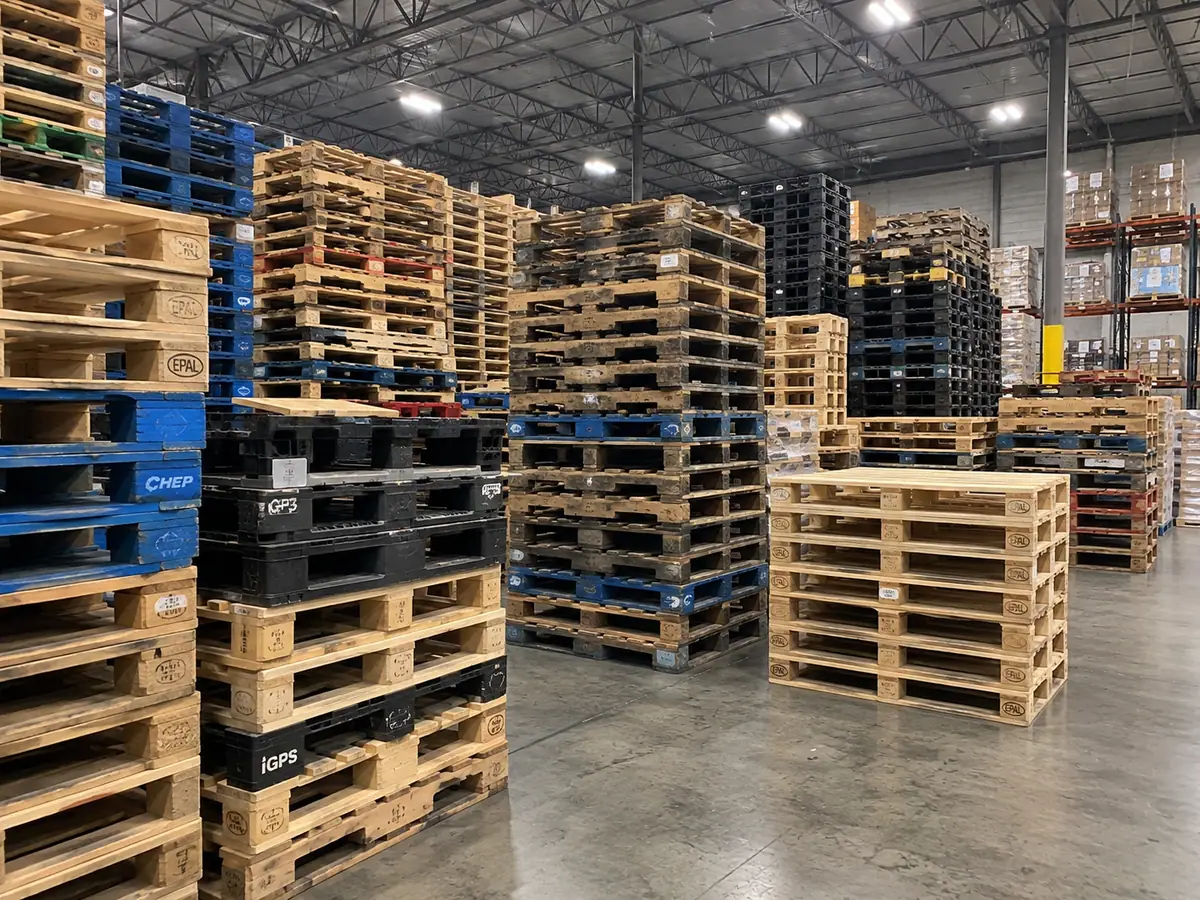
Ask us about anything on this page
These guides are written by the people who grade the pallets. If something here does not match your situation, tell us in the message field.
- Written quotes, usually inside one business day
- Loads from 100 pallets to full 53' trailers
- We buy as readily as we sell — tell us which way it flows
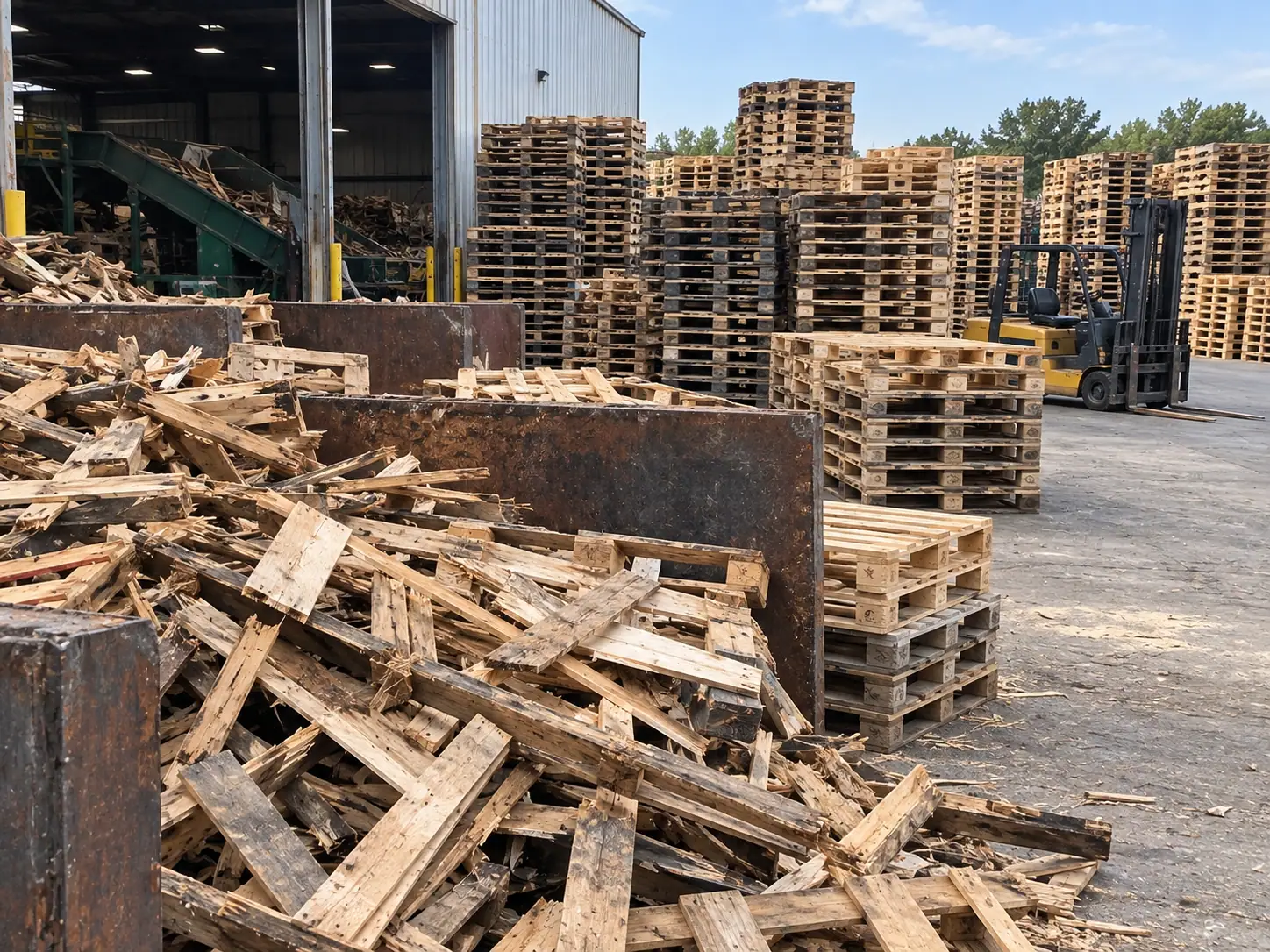
The last four per cent
Everything the sort deck rejected, on its way to the grinder. It leaves as mulch, bedding and boiler fibre — not as landfill.
Head to head
The comparison, 48 × 40 GMA
| Recycled Grade A | Recycled Grade B | New hardwood | New SPF | |
|---|---|---|---|---|
| Unit price | $7.50 – $12.00 | $5.00 – $8.50 | $19 – $22 | $17 – $19 |
| Weight | 45 – 55 lb | 45 – 55 lb | 50 – 60 lb | 35 – 42 lb |
| Static load | ≈ 6,000 lb | ≈ 4,500 lb | ≈ 6,500 lb | ≈ 4,500 lb |
| Racked load | ≈ 2,100 lb | ≈ 1,500 lb | ≈ 2,500 lb | ≈ 1,600 lb |
| Moisture at dispatch | Under 19% | Under 19% | 15 – 20% if KD | Often 19 – 28% green |
| Dimensional consistency | Good | Fair | Excellent | Excellent |
| Remaining service life | 3 – 5 cycles | 1 – 3 cycles | 10 – 25 cycles | 8 – 15 cycles |
| Lead time | Same / next day | Same / next day | 2 weeks | 2 weeks |
| Embodied CO₂e | ≈ 1.2 kg | ≈ 1.2 kg | ≈ 15 – 17 kg | ≈ 12 – 14 kg |
The counterintuitive bit
New is not automatically stronger
A new pallet built from green SPF with 5/16-inch deck boards is measurably weaker than a Grade A recycled hardwood GMA with 9/16-inch boards. 'New' describes the wood's history, not its performance.
There is also a selection effect working in recycled wood's favour. A pallet that has survived three years of service has demonstrably not warped, split or loosened. New softwood at 25 to 30% moisture content has all of its drying still ahead of it, and much of the failure in a new pallet's first year comes from that drying rather than from load.
So the strength comparison is not recycled-versus-new. It is deck thickness, species and moisture — three variables you should ask about regardless of which you buy.
When new genuinely wins
Four cases where we will tell you to buy new
- 01Automated handlingAS/RS, shuttle systems and high-speed conveyors specify tolerances recycled stock cannot reliably hold. A jam costs more than the pallet saving, every time.
- 02Documented load ratingsIf an insurer or a customer requires a tested ISO 8611 rating, that requires a consistent build. Recycled variability makes a rating meaningless.
- 03Long internal service lifeForty cycles a year for five years inside your own building. On cost per cycle, new wins comfortably.
- 04Appearance-critical retailDisplay pallets the shopper sees. A recycled deck reads as tired even when it is structurally perfect. Though ask about display grade first — it is much cheaper than new.
The carbon question
This one is not close.
A new 48×40 wood pallet carries roughly 15 to 17 kg CO₂e of cradle-to-gate emissions: harvesting, sawing, drying, fastening and transport. A recycled unit carries the emissions of collection, sorting and repair — around 1.2 kg.
That is more than a tenfold difference, and it holds up under most methodological choices you could reasonably make. It is the least ambiguous argument in this entire comparison.
The nuance worth stating: if a recycled pallet fails early and gets replaced twice as often, some of that advantage erodes. It does not come close to eliminating it. Run your own volumes through the Reclaim Index.
- New: ≈ 15 – 17 kg CO₂e per 48×40 unit, cradle to gate
- Recycled: ≈ 1.2 kg CO₂e per unit, collection to dispatch
- 24 board feet of lumber not milled per recycled unit
- ≈ 45 lb of wood kept in service rather than ground or buried
Questions
Recycled vs new questions
Which is cheaper overall?
Recycled, for anything that leaves your building. New, for high-cycle internal fleets. The crossover is roughly eight to ten cycles, which is a useful number to hold in your head.
Will my customers object to recycled pallets?
Some will, in writing, in their receiving standard. Most will not notice. Ask before you switch — it is a two-minute conversation that avoids a rejected load.
Is recycled stock consistently available?
For 48×40 GMA, yes, everywhere, all year. For specialty footprints it comes in batches and lead times stretch. See the size library.
Can I mix them?
Yes, and most operations do: new for the internal returnable fleet, recycled for outbound. Just label the stacks so the two do not merge.
If new does not automatically mean stronger, what should I ask about instead?
Three things, of every quote: deck board thickness, stringer species and moisture content at dispatch. A 9/16-inch hardwood deck outperforms a 5/16-inch one whatever the pallet's history is, and new SPF often arrives at 19 to 28% moisture with all of its drying — and therefore most of its warping and fastener loosening — still ahead of it. Those three answers tell you more about performance than the words recycled or new ever will.
Tell us where the pallet goes and whether it comes back.
Those two facts decide this question. Everything else is detail.