Tool 01 · interactive
How many pallets actually fit on that trailer?
Price the load you just planned
Put the total from the planner into the quantity field and we will quote the pallets and the freight together.
- Written quotes, usually inside one business day
- Loads from 100 pallets to full 53' trailers
- We buy as readily as we sell — tell us which way it flows
Segregation
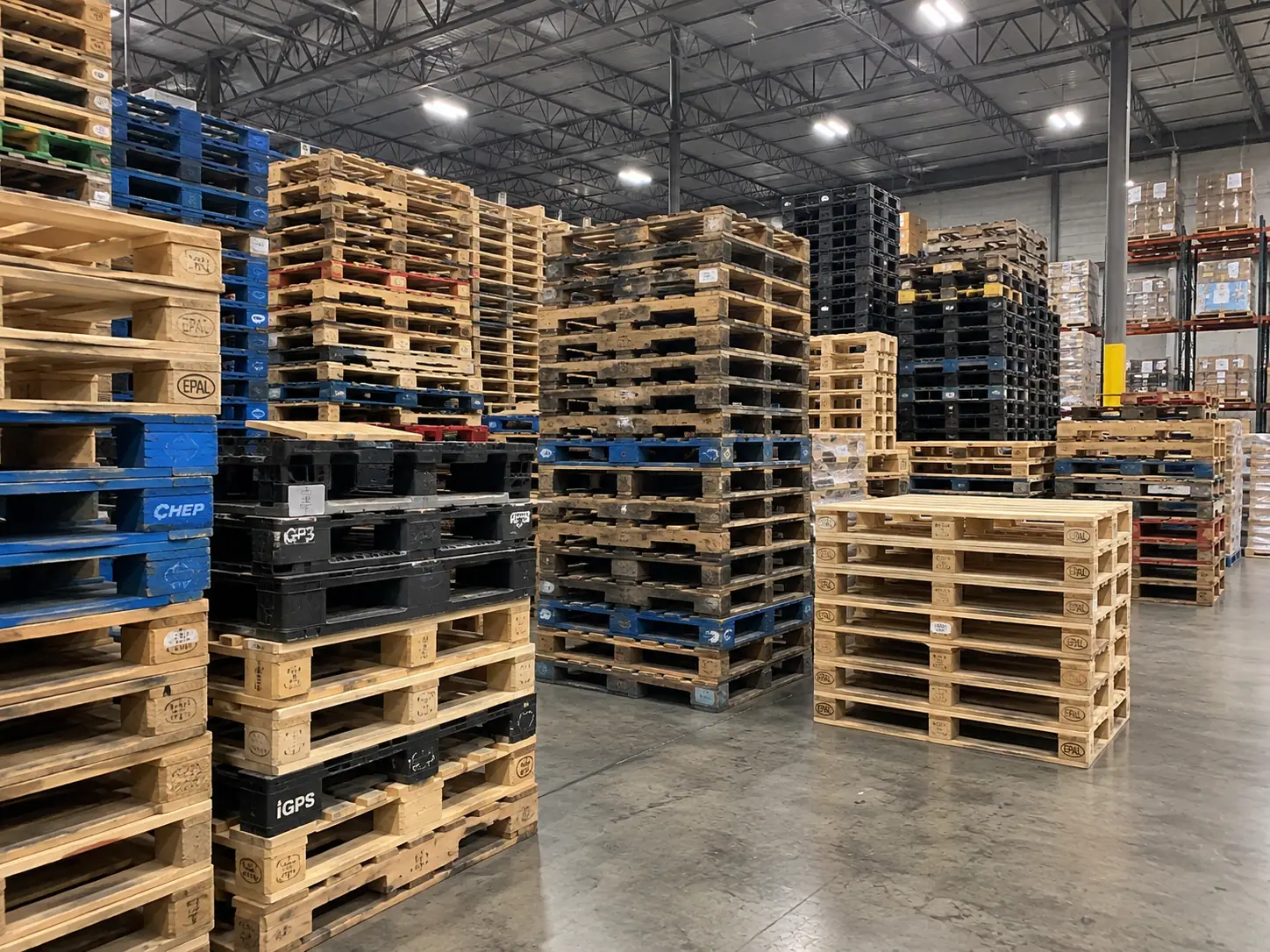
Sorted by type, not by convenience. Pooled units go back to the pool; plastic runs a separate stream entirely.
Load planner
How many actually fit.
Most calculators multiply two numbers. This one tries every mixed orientation and draws the arrangement that wins.
60pallets total
30 on the floor · 2 high
30 loaded turned
Floor utilisation
93.3%
Single-orientation
30 on the floor
Mixed gains
0 pallets
Footprint
48″ × 40″
The planner works through every possible split — nought straight columns then all turned, one straight column then the rest turned, and so on in both directions — and keeps whichever produces the highest count. It then draws that arrangement to scale.
What it does not model is the rest of reality: product overhang, load height, weight distribution across the axles, and whether the receiving dock will accept a stacked pallet at all. Those decide more loads than geometry does.
Use it as a ceiling rather than a plan, and check the number against what your loaders can actually achieve.
Questions
About the planner.
Why is the usable width 98 inches and not 102?
102 inches is the legal exterior width. Interior usable width on a standard dry van is 98 to 100 inches once you account for wall thickness, logistics posts and the fact that nothing in a warehouse is perfectly square. We use 98 to keep the answer achievable.
Can I really load a mixed orientation?
Yes, and experienced loaders do it constantly — it is usually called pinwheeling when the pattern alternates. What it costs is loading time, and on a tight dock that trade is not always worth it.
Why does stacking three high rarely appear in real loads?
Interior height gives you the room, but forklift mast height at both ends, stack stability in transit and the receiver’s policy usually do not. Where all three line up it is a genuine saving.
Does this work for custom footprints?
Yes — put your own length and width into the custom fields and the plan recalculates. It is a useful sanity check before committing to a non-standard size.
Does the planner account for weight limits?
It does not, and for pallets it does not need to. A full trailer of empty pallets weighs about 15,000 lb against a legal payload near 45,000, so the load cubes out long before it grosses out and the floor plan is the binding constraint. What the planner also does not model is product overhang, load height, axle distribution and whether the receiving dock will accept a stacked pallet at all — treat the number as a ceiling rather than a plan.
Weight, not cube
One inch of overhang