The thing nobody else does
Every load can ship with a passport.
Request a passport with your next order
Put 'passport' in the message field and it ships with the load. There is no charge for it — it is generated from records we keep anyway.
- Written quotes, usually inside one business day
- Loads from 100 pallets to full 53' trailers
- We buy as readily as we sell — tell us which way it flows
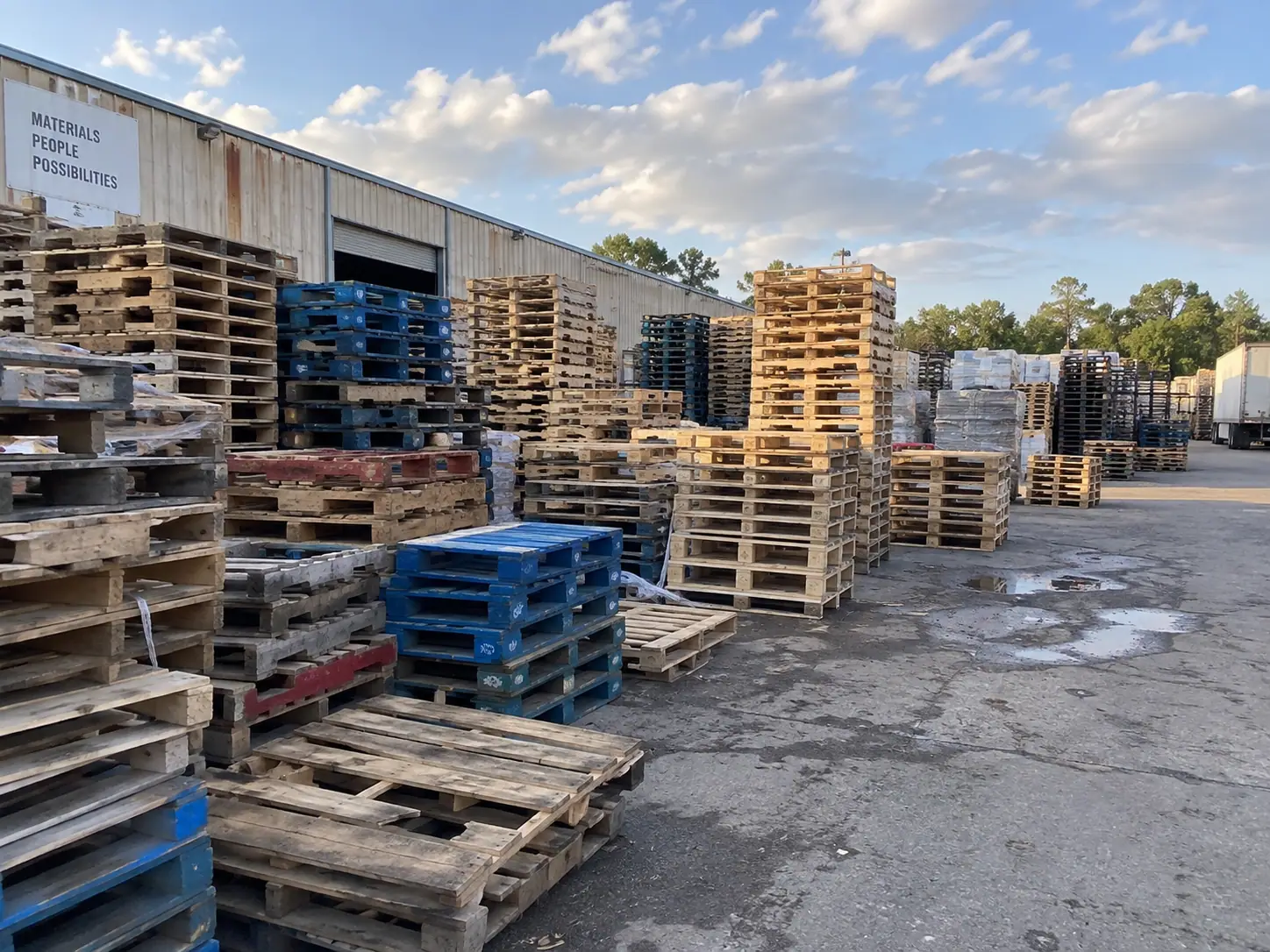
Intake
Mixed cores straight off a collection run. Every one of these gets a grader's four-way decision before it goes anywhere.
Supply chains have spent twenty years building traceability into everything except the thing the product is sitting on. You can trace a case of tomatoes to a field and a week. The pallet under it is anonymous.
That anonymity is why pallet sustainability claims are so weak. Without a record of what happened to specific wood, all anyone can offer is an industry average — and an industry average is not evidence, it is a genre of marketing.
So in 2022 we built the Passport. It is not clever technology: it is the records that already exist in our yard, assembled into one page and attached to the load. The novelty is entirely that nobody else bothers.
Try it
Build a preview passport.
Build a preview
Set the load. The passport on the right redraws from our published yard averages — the same ones we use for the real document that ships with your order.
Footprint
48" × 40" GMA
Grade issued
Grade A (#1)
Units
480
Recovered wood
21,600 lb
Where the boards came from
- 62% Reused as-is
- 31% Repaired
- 5% Remilled
- 2% To fibre
7.39
t CO₂e
Avoided
10.8
short tons
Diverted
11,520
board feet
Not milled
How it is produced
Four records, one page.
- Step 01
The scale ticket
Every inbound load is weighed gross and tare. This is the origin of every weight figure on the Passport, and the record an auditor will ask to see first.
Station 01 of the [yard process](/services/pallet-recycling/process).
- Step 02
The grading log
Each unit is sorted into reuse, repair, dismantle or grind. Aggregated across the load, that log becomes the provenance bar on the document.
Recorded at the sort deck, not estimated afterwards.
- Step 03
The repair count
How many units were repaired and with what — recovered lumber or new. This is the field customers ask about most and the one most suppliers cannot answer.
Roughly 40% of repairs use same-day recovered boards.
- Step 04
The outbound record
Grade issued, unit count, footprint and dispatch weight. Reconciled against the inbound figures before the document is released.
Station 09. Any variance is noted, not smoothed.
Why it matters commercially
Your sustainability report writes itself.
If you report against GRI 306, a corporate zero-waste target or a customer’s supplier scorecard, the hard part is never the intention. It is producing evidence for a material stream that nobody instrumented.
The Passport is that evidence, at the level of granularity those frameworks actually ask for: tonnage, outcome and traceability to a primary record.
How diversion is measuredFor sustainability teams
Per-shipment tonnage by outcome, reconciled to weight tickets. Enough to support a disclosure without an estimate anywhere in the chain.
For procurement
Grade issued against grade ordered, in writing, with the repair share visible. A quality record as much as an environmental one.
For your customers
Several of our customers pass the Passport straight through to their own customers as supporting evidence in supplier scorecards.
For auditors
A document that names its primary records and admits its variance, rather than a marketing figure with no working shown.
Questions
About the Passport.
Does it cost anything?
No. It is assembled from records we produce anyway. Program customers receive one with every shipment automatically; anyone else can request one by asking.
How specific is it really?
Specific to the load. Weights and unit counts come from that shipment’s own records. Where a figure is a yard average rather than a load-specific measurement — the carbon figures, for instance — the document says so on its face.
Can it identify the previous owner of the wood?
No, and deliberately. We name the collection region and the source sector, not the source company. Our collection customers are entitled to the same discretion you are.
Is it verified by anyone external?
Not currently. The underlying records are auditable and we will walk any auditor through them, but the Passport itself is our own document and we describe it as such rather than implying third-party certification.
What if the numbers look worse than the average?
Then that is what it says. A load of wet, broken cores diverts almost entirely to fibre rather than to reuse, and the Passport reports that honestly. A document that always flatters the load would not be worth issuing.
What the preview above is
What a real one is
Keep reading
- Zero-waste promiseHow the underlying figures are measuredRead
- Carbon methodologyWhere the modelled figures come fromRead
- Inside the processThe nine stations that produce the recordsRead
- Managed programsAutomatic passports on every loadRead
- The Reclaim IndexModel your annual figuresRead
- Food & beverageWhere provenance matters mostRead