Tool 04 · interactive
What the stamp on your stringer actually says.
Order export-ready stock
Tell us the destination country in the message field — it changes the answer more than the pallet does.
- Written quotes, usually inside one business day
- Loads from 100 pallets to full 53' trailers
- We buy as readily as we sell — tell us which way it flows
Intake
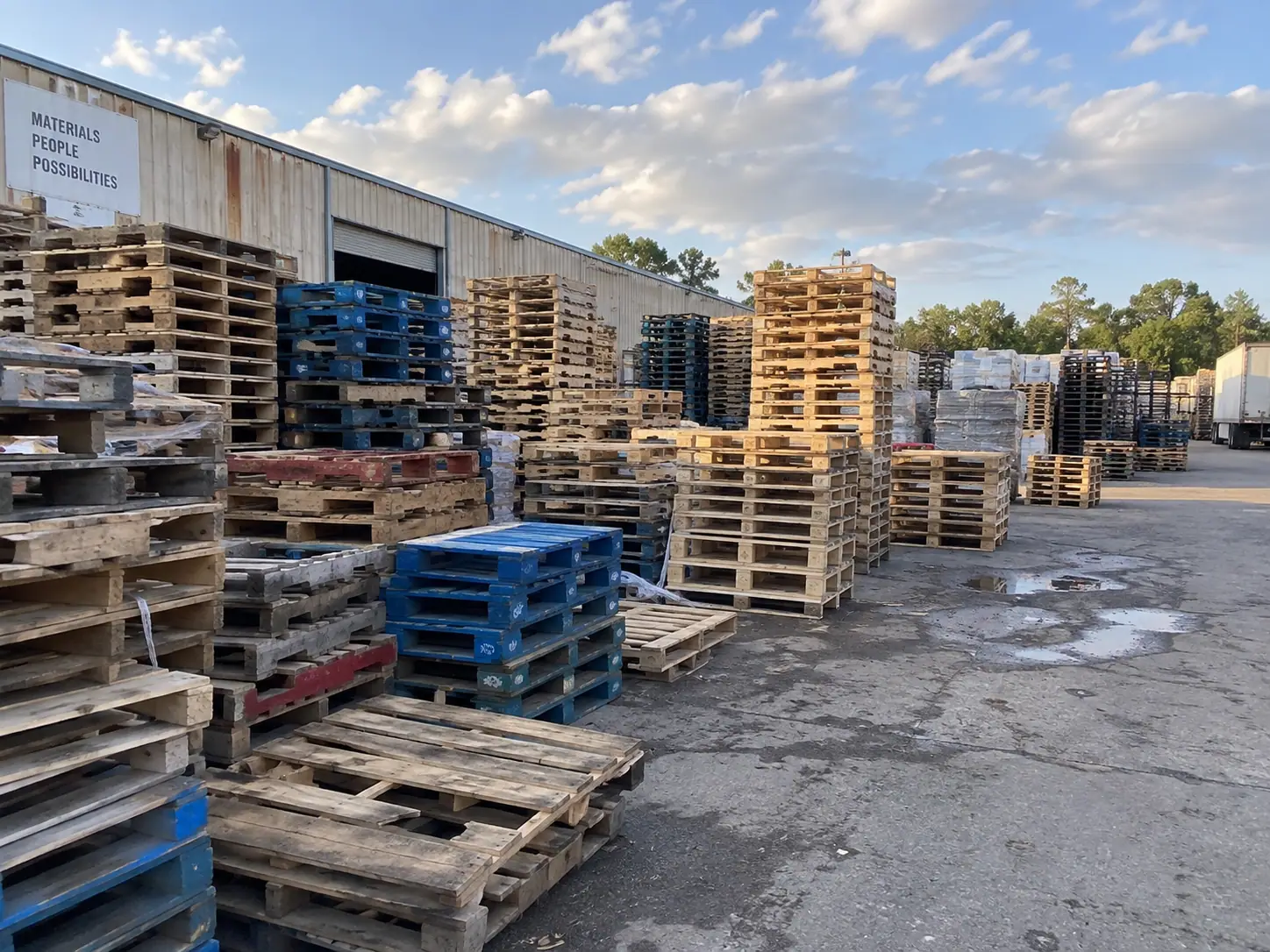
Mixed cores straight off a collection run. Every one of these gets a grader's four-way decision before it goes anywhere.
Stamp decoder
Read the mark on the stringer.
Set the elements you can see on your pallet and the stamp redraws, with each part explained. Four elements, and every one of them matters.
Issued by the national plant protection organisation. No number, no certification.
What it looks like
Reads as a valid ISPM-15 mark
Wheat symbol, country code US, registration 0472, treatment HT. Provided it is legible, permanent and present on at least two opposing sides, this is what an inspector expects to see.
- The wheat symbol
- Mandatory. A plain text stamp without it is not an ISPM-15 mark, whatever else it says.
- US — country code
- The ISO code of the country whose plant protection organisation registered the treatment facility. Here: United States.
- 0472 — facility registration
- Identifies who performed the treatment. Applying a mark without holding a registration is fraud rather than a shortcut.
- HT — Heat treatment
- The wood was heated until its core reached at least 56 °C and held there for a minimum of thirty continuous minutes. This is the ordinary, widely accepted treatment and the one you will see on most compliant packaging.
The mark must be legible, permanent and applied to at least two opposing sides. Full detail in ISPM-15 explained.
The rule is simple. The failures almost never are, because they happen after treatment rather than during it: a compliant pallet repaired with an untreated board, a shipping label applied across the mark, a KD stamp mistaken for an HT one, or a strip of bark left on a stringer edge.
The single most common failure we see is the repair. A marked pallet repaired with ordinary recovered lumber still carries a valid-looking stamp and is no longer compliant, and nobody in the chain notices until an inspector does.
Questions
Reading the mark.
Do I need this for domestic shipping?
No. ISPM-15 governs international movement of solid wood packaging. Columbus to Cleveland, it is irrelevant, and paying for treatment is money wasted.
Is kiln dried the same as heat treated?
No, and the confusion is expensive. KD is a moisture process with different parameters. A KD stamp on its own is not an ISPM-15 mark and will not clear customs.
What happens if the mark is covered?
It is treated as absent. The mark must be legible on at least two opposing sides, and an inspector is not obliged to peel your labelling off to find it.
Are plastic pallets exempt?
Entirely — ISPM-15 covers solid wood only. On a high-frequency export lane the avoided treatment cost and avoided hold risk can justify plastic on their own.
Does repairing a treated pallet invalidate the mark?
It does if the replacement wood was not itself treated, and this is the single most common failure we see. A marked pallet repaired with ordinary recovered lumber still carries a valid-looking stamp and is no longer compliant, and nobody in the chain notices until an inspector does. The treatment itself is a core temperature of 56 °C held for at least thirty continuous minutes, so a board that never went through a chamber cannot be covered by the original mark.
The question to ask your repair yard
Confirm per lane, not per year