Product 06
Collars, lids, runners and the small parts that make a pallet a container.
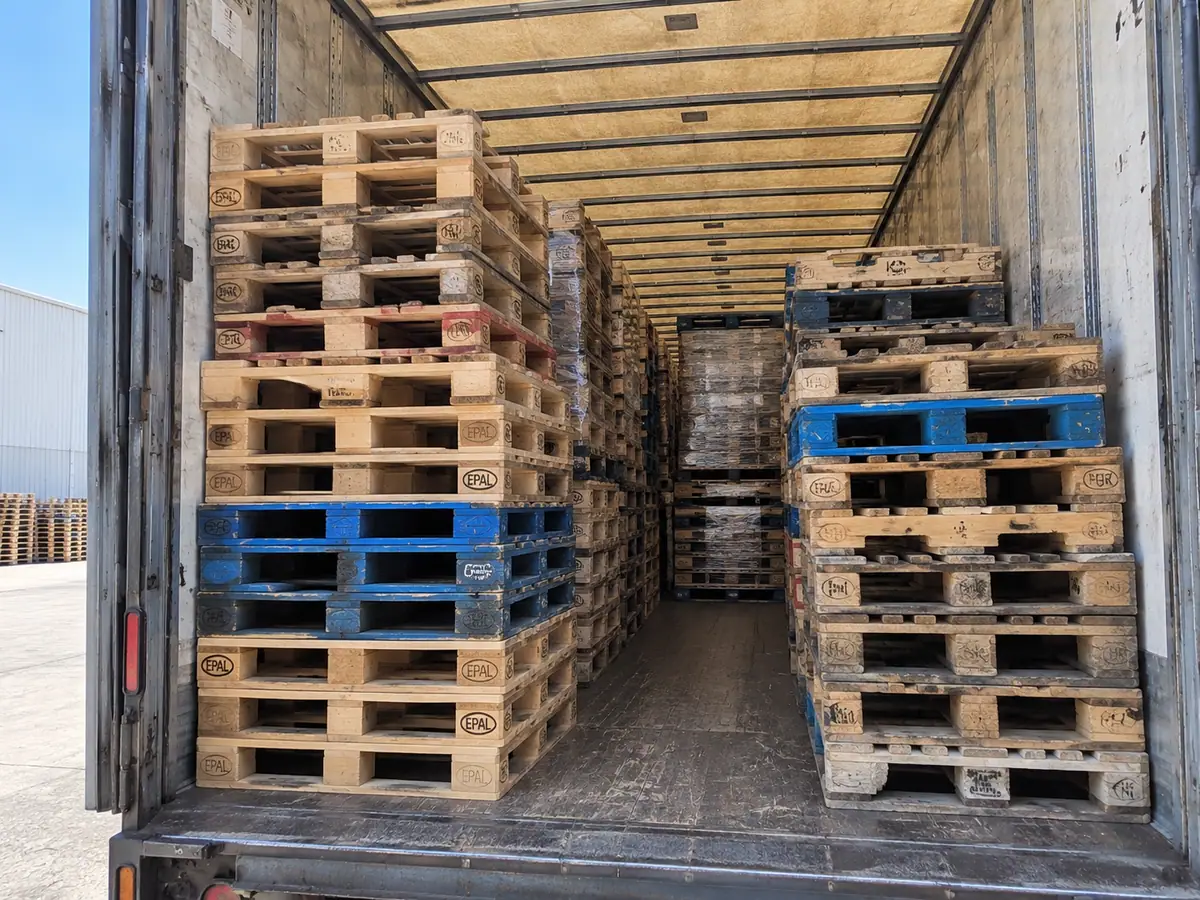
Price collars and accessories
Give us the quantity, the size and the ZIP. You'll get a written quote with the grade, the freight and the pickup window — not a sales call.
- Written quotes, usually inside one business day
- Loads from 100 pallets to full 53' trailers
- We buy as readily as we sell — tell us which way it flows
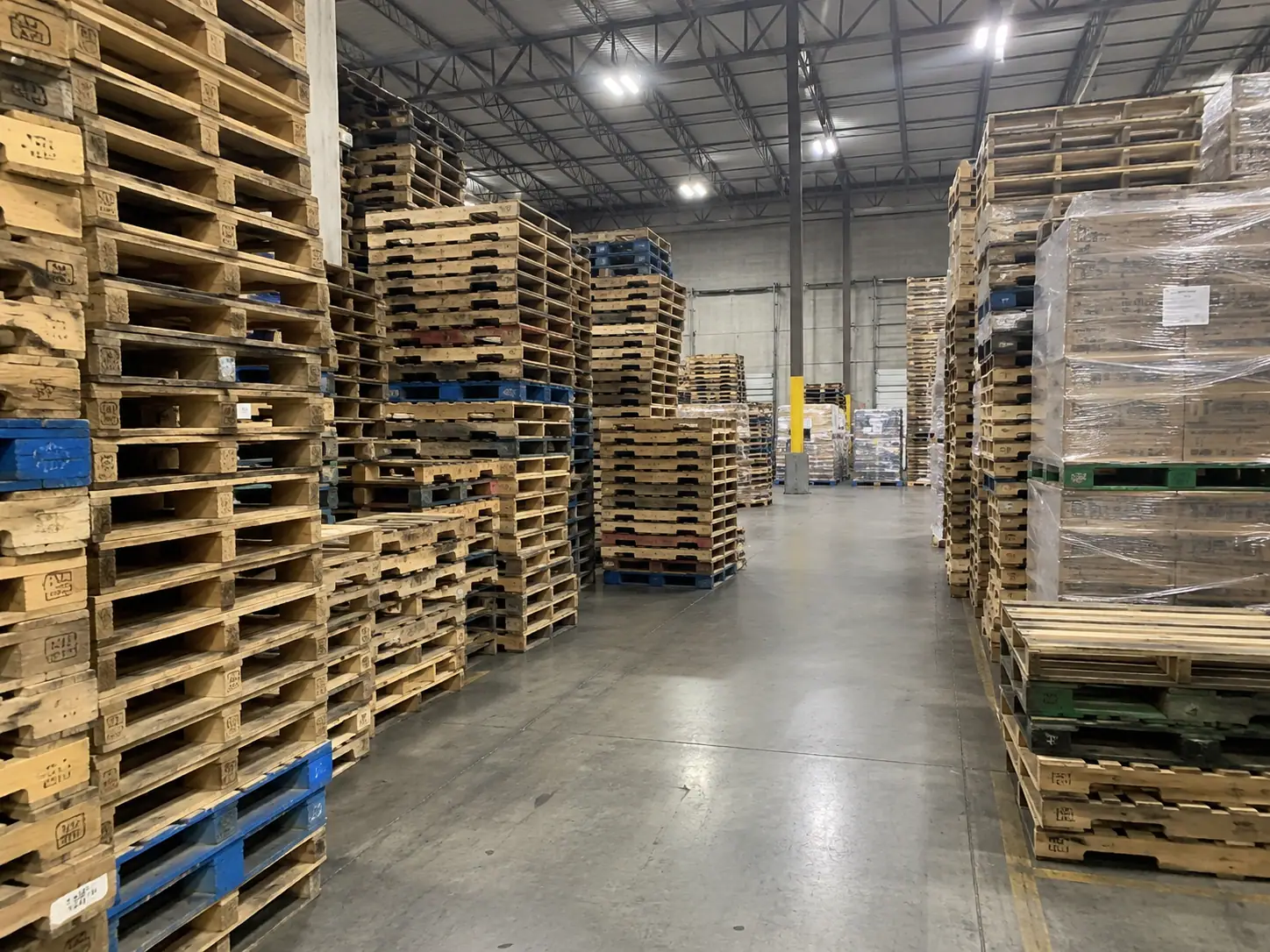
Inside the building
The sort aisle at half past seven. Graded stock on the left, waiting to be worked on the right.
The catalogue
What we carry
| Item | Sizes | New / used | Typical use |
|---|---|---|---|
| Hinged pallet collars | 48×40, 1200×800, 1200×1000 | Both | Modular containers, bulk parts, seasonal storage |
| Pallet lids | 48×40, Euro | Both | Closing a collared stack; weather protection |
| Top caps / top frames | 48×40 | New | Load stabilisation under stretch wrap |
| Corner boards | 36″, 48″, 60″ | New | Protecting edges under banding |
| Runners and bearers | Cut to length | Both | Converting a pallet to a skid; raising a load |
| Anti-slip sheets | 48×40 | New | Preventing layer shift on smooth product |
| Steel and poly banding | Various | New | Securing stacks and collared loads |
| Pallet feet and blocks | Standard | Both | Repairs and block-pallet conversions |
Why collars keep winning
The container that disappears when it is empty.
The whole economic problem with returnable containers is the return leg: you pay to move air. A collapsible collar system reduces the return cube by about eighty per cent, and that is usually the difference between a reusable programme that works and one that quietly gets abandoned.
They are also repairable in a way plastic totes are not. A split collar board is a five-minute fix with a hammer and a recovered board. A cracked plastic tote is scrap.
- Stack to any height in 200 mm increments
- Fold to roughly 4 inches when empty — 80% cube reduction on the return leg
- Repairable with recovered lumber
- Compatible with standard 48×40 and Euro footprints
- Used collars available at roughly half the price of new
Questions
Accessory questions
Do collars fit any pallet?
They fit the footprint they were built for. A 1200×800 Euro collar will not sit correctly on a 48×40 GMA — it overhangs on one axis and is short on the other. Order to the footprint you actually run.
How many collars can you stack?
Mechanically, four to six is common. The real limit is the load and your racking, not the collars. Above four we would want to know what is inside.
Are used collars worth it?
Usually yes. Collars fail at the hinges rather than the boards, and hinge condition is easy to inspect. Ask for photos before a large order and we will send them.
Can you make custom collars?
Yes, to any footprint we can build a pallet for. See custom builds.
Sizing reference
Collar dimensions and what stacks with what
| Item | Footprint | Height | Material | Notes |
|---|---|---|---|---|
| Collar, 4-hinge | 48″ × 40″ | 7⅞″ (200 mm) | Softwood, hinged steel | Standard GMA-compatible height increment |
| Collar, 4-hinge Euro | 1200 × 800 mm | 200 mm | Softwood, hinged steel | EPAL-compatible footprint |
| Collar, 4-hinge industrial | 1200 × 1000 mm | 200 mm | Softwood, hinged steel | For EUR 2 base pallets |
| Lid, plywood | 48″ × 40″ | ½″ | Plywood, framed | Closes a collared stack |
| Top frame | 48″ × 40″ | 1½″ | Softwood | Load stabilisation under stretch wrap |
| Corner board | 36″, 48″, 60″ | 2″ × 2″ leg | Laminated paperboard | Protects edges under banding |
| Anti-slip sheet | 48″ × 40″ | — | Coated paper | Prevents layer shift on smooth product |
| Runner / bearer | Cut to length | 1⅜″ – 1⅝″ | Hardwood | Converts a pallet to a skid, raises a load |
Building a collar system
How to size a returnable container properly
Start from the load height, not the pallet. Collars stack in 200 mm increments, so a load 620 mm tall needs four collars rather than three. Getting this wrong means either a lid that does not sit or wasted height on every return leg.
Count the return cube, not just the outbound. The entire economic argument for collars is that they fold to about four inches empty — roughly an eighty per cent reduction against a rigid container. If your return logistics do not actually exploit that, a rigid tote may be simpler.
Match the footprint exactly. A 1200 × 800 Euro collar will not sit correctly on a 48 × 40 GMA. It overhangs on one axis and is short on the other, and the assembly is neither stable nor safe.
Inspect the hinges, not the boards. Collars fail at the hinges. Used collars are usually excellent value and hinge condition is easy to check — ask for photographs before a large order and we will send them.
Common uses
Where collars beat the alternatives
- 01Variable-height loadsWhere the same product ships in different quantities. Add or remove a collar rather than stocking three container sizes.
- 02Returnable programmes with a long return legThe fold-flat return is worth more the further the goods travel. Over long distances it is frequently the difference between viable and not.
- 03Seasonal storageAgriculture and horticulture, where containers are needed for eight weeks and stored flat for forty-four.
- 04Mixed automotive partsWhere a bin needs to be openable from the side for line-side picking. Drop the front collar rather than lifting over a wall.
- 05Anywhere a tote would be scrappedA split collar board is a five-minute repair with a recovered board. A cracked plastic tote is scrap.
Questions
More accessory questions
How many collars can safely stack?
Mechanically four to six is common. The real limit is the load and your racking rather than the collars, and above four we would want to know what is inside.
Do collars need to match the pallet manufacturer?
No, only the footprint. A standard 48×40 collar sits on any sound 48×40 pallet, regardless of who built either.
Are used collars worth buying?
Usually — around half the price of new and the failure mode is inspectable. Check hinge condition and whether any boards are split at the hinge fixing.
Can you make custom-size collars?
To any footprint we can build a pallet for. It carries the same illiquidity warning as any custom footprint — see the custom sizing guide.
Do corner boards actually help?
Under banding, considerably. They spread the strap load across the case corners rather than concentrating it on one edge, which is where crush damage starts on a wrapped load.
Collars, lids and a pallet make a container.
Tell us the footprint and the height you need and we will price the whole assembly rather than the parts.