Service 04 — Recycling
Pallet recycling that ends with a product, not a hole in the ground.
Talk to us about a recycling program
Give us the quantity, the size and the ZIP. You'll get a written quote with the grade, the freight and the pickup window — not a sales call.
- Written quotes, usually inside one business day
- Loads from 100 pallets to full 53' trailers
- We buy as readily as we sell — tell us which way it flows
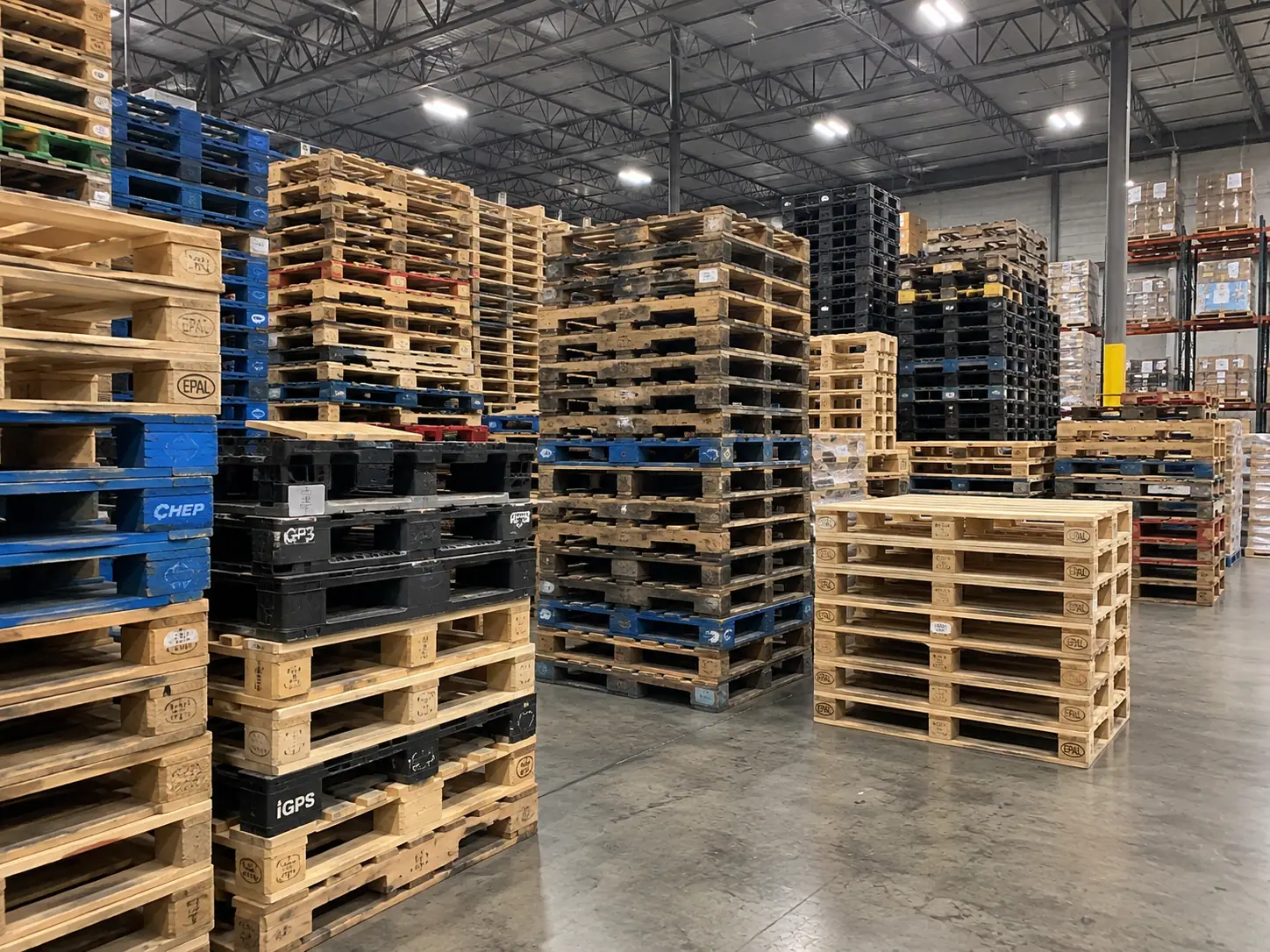
Segregation
Sorted by type, not by convenience. Pooled units go back to the pool; plastic runs a separate stream entirely.
The decision tree
Four outcomes, decided one pallet at a time.
- Step 01
Reuse
Sound deck, sound stringers, correct footprint, dry. Cleaned, banded, graded and back on a trailer. Roughly 34% of intake goes straight out again.
The cheapest possible outcome, environmentally and financially.
- Step 02
Repair
One or two broken boards, or a stringer that can take a companion. Broken parts come off, recovered boards go on, and the unit re-enters at the grade it now genuinely meets.
Repaired with salvaged lumber wherever the spec allows.
- Step 03
Dismantle
Beyond economic repair as a unit, but full of good wood. A dismantler pulls it apart; the boards become repair stock and the stringers get cut down for shorter builds.
This is where most of our repair lumber comes from.
- Step 04
Grind
Wet, mouldy, splintered or too small to save. Ground, screened and magnetically de-nailed into landscape mulch, animal bedding and boiler fibre.
Still a product. Still not a landfill.
What we cannot recycle
The 0.6%, and why we publish it.
Some wood should not be reused or ground. Pallets that carried a chemical spill, pallets treated with methyl bromide, painted or pressure-treated units, and anything visibly contaminated with oil or biological waste go to a permitted disposal facility rather than into a mulch stream that ends up on somebody's flower bed.
It would be easy to leave that number out of our marketing. We publish it because a company claiming 100% diversion is either not handling difficult material or is not being straight with you.
- Methyl bromide (MB-stamped) treated wood
- Painted, stained or pressure-treated lumber
- Chemical, oil or biologically contaminated units
- Composite and moulded units with non-wood binders we cannot separate
The outputs
What comes out of the yard
| Output | Share of intake | Where it goes |
|---|---|---|
| Graded pallets, reused as-is | 34% | Back to distribution customers across six states |
| Repaired pallets | 24% | Resold as Grade A and B recycled stock |
| Recovered lumber | 27% | Repair stock, remanufactured pallets, crates and skids |
| Coloured and dyed mulch | 9% | Landscape suppliers and municipal contracts |
| Animal bedding and boiler fibre | 5% | Agricultural buyers and industrial boilers |
| Ferrous scrap | 0.4% | Scrap metal processors |
| Landfilled | 0.6% | Permitted disposal — treated and contaminated wood only |
Why it matters more than it sounds
A pallet is a carbon store with a job
Wood is roughly half carbon by dry weight. A 45-pound recycled hardwood pallet is holding something like 10 kilograms of carbon that came out of the atmosphere while the tree was standing. Burn it or bury it and that story ends; keep it in service for another eight cycles and the carbon stays put while doing useful work.
That is why reuse beats recycling and recycling beats energy recovery, in that order, every time. The hierarchy is not sentimental — it follows directly from where the embodied energy sits. Our full arithmetic, with the coefficients and their sources, is on the carbon methodology page.
If you want to see the mechanics of the yard rather than the philosophy, the recycling process walkthrough follows a single trailer from the gate to the outbound dock.
Questions
Recycling questions
Do you charge for recycling, or pay for it?
It depends entirely on what is in the load. Sellable cores are a purchase; broken and mixed material is a removal fee, usually $95 to $180 per trailer in central Ohio. A mixed load often nets out close to zero.
Can you handle heat-treated and export pallets?
Yes. Heat treatment is just heat — the wood is unchanged and recycles normally. Methyl bromide treatment is different and that material is segregated. See ISPM-15 explained.
How do I prove diversion to an auditor?
Weight tickets per collection plus a monthly diversion statement showing tonnage in and tonnage by outcome. That is the level of evidence a GRI 306 disclosure actually needs.
What happens to the nails?
Magnetically separated at the grinder and sold as ferrous scrap. About 0.4% of intake weight, which sounds trivial until you consider it is roughly 160 tons a year across the industry in a city this size.
Reporting
What you get, and which framework it satisfies
| Document | Frequency | Contains | Satisfies |
|---|---|---|---|
| Collection count ticket | Every pickup | Units by type, signed by both parties | Internal reconciliation, dispute resolution |
| Weight ticket | Every inbound load | Gross, tare, net weight from our scale | The primary record for any tonnage claim |
| Monthly diversion statement | Monthly | Tonnage in, tonnage by outcome, landfill tonnage, variance | GRI 306, corporate zero-waste targets |
| Disposal documentation | As required | Facility and tonnage for permitted disposal | Regulatory and audit trails |
| Pallet Passport | Per shipment | Provenance, grade, reuse and repair shares | Supplier scorecards, customer evidence |
| Annual summary | Yearly | Twelve-month roll-up with year-on-year comparison | Annual reporting cycles |
Contamination
What to keep out of the stream, and why
- 01Methyl-bromide stamped unitsLook for MB in the treatment code on the IPPC mark. We exclude this material entirely, regardless of condition — the stamp decoder shows you exactly where to look.
- 02Pressure-treated and painted lumberGreen or brown treated timber and anything painted. It has no business in a landscape mulch stream and we will not put it there.
- 03Chemically contaminated palletsAnything that carried a spill, or that has staining or an odour you cannot account for. Segregate it and tell us — we will route it to permitted disposal rather than pretending.
- 04Composite and presswood unitsMoulded and pressed units with non-wood binders that cannot be separated from the fibre. Small volumes, but they contaminate a grind.
- 05General waste in the pileFilm, banding, strapping and cardboard mixed into a pallet stack. Ferrous banding we handle magnetically; film and cardboard we do not, and they slow the whole line.
Yard throughput
What the operation handles
6,400
Pallets received a day
Across roughly 19 inbound trailers.
2.5 sec
Per grading decision
Four-way judgement, by hand, all day.
4 hrs
Gate to gate
Typical load, received before the 1:00 PM cut-off.
1 in 640
Mis-grade rate
Found by our own 2% outbound re-check.
Questions
More recycling questions
Can you recycle pallets we did not buy from you?
Yes — most of what we process was never ours. Origin makes no difference to whether we can handle it; condition and contamination do.
What happens to pallets that carried food?
They recycle normally. Food residue is an ordinary organic contaminant that the sorting and grinding process handles. What we segregate is chemical contamination and treated wood, which is a different question entirely.
Do you provide a certificate of destruction?
For branded or marked material that must not re-enter circulation, yes. Tell us at collection and it is handled as a separate, documented stream rather than mixed into general intake.
How do we compare your diversion rate with another supplier's?
Ask three questions: is it measured by weight or by count, what is the landfill percentage, and does it count energy recovery as diversion. Any of those can move a headline figure by ten points. Ours is by weight, 0.6% landfill, and we state boiler fibre separately at 2.0% so you can exclude it.
Is there a minimum volume for a recycling programme?
Around a trailer of empties a fortnight makes a scheduled programme worthwhile. Below that, transactional collection is simpler and the reporting is the same.
Recycling is a supply chain, not a skip.
Set up a program and you get the collection, the reporting and, in most cases, a supply of graded stock coming back the other way.
Keep reading
Pallet Recycling is delivered from our yard at 7240 S Access Rd, Columbus, OH 43217, Monday to Friday 7:00 AM to 5:00 PM and Saturday mornings.