72 terms
A pallet glossary written for people who did not grow up in a yard.
Every term used anywhere on this site, defined plainly. Where a definition is contested in the industry — and several are — we say so rather than pretending there is a settled answer.
A term we have missed?
Tell us in the message field and we will add it. This page grows mostly from customer questions.
- Written quotes, usually inside one business day
- Loads from 100 pallets to full 53' trailers
- We buy as readily as we sell — tell us which way it flows
Inside the building
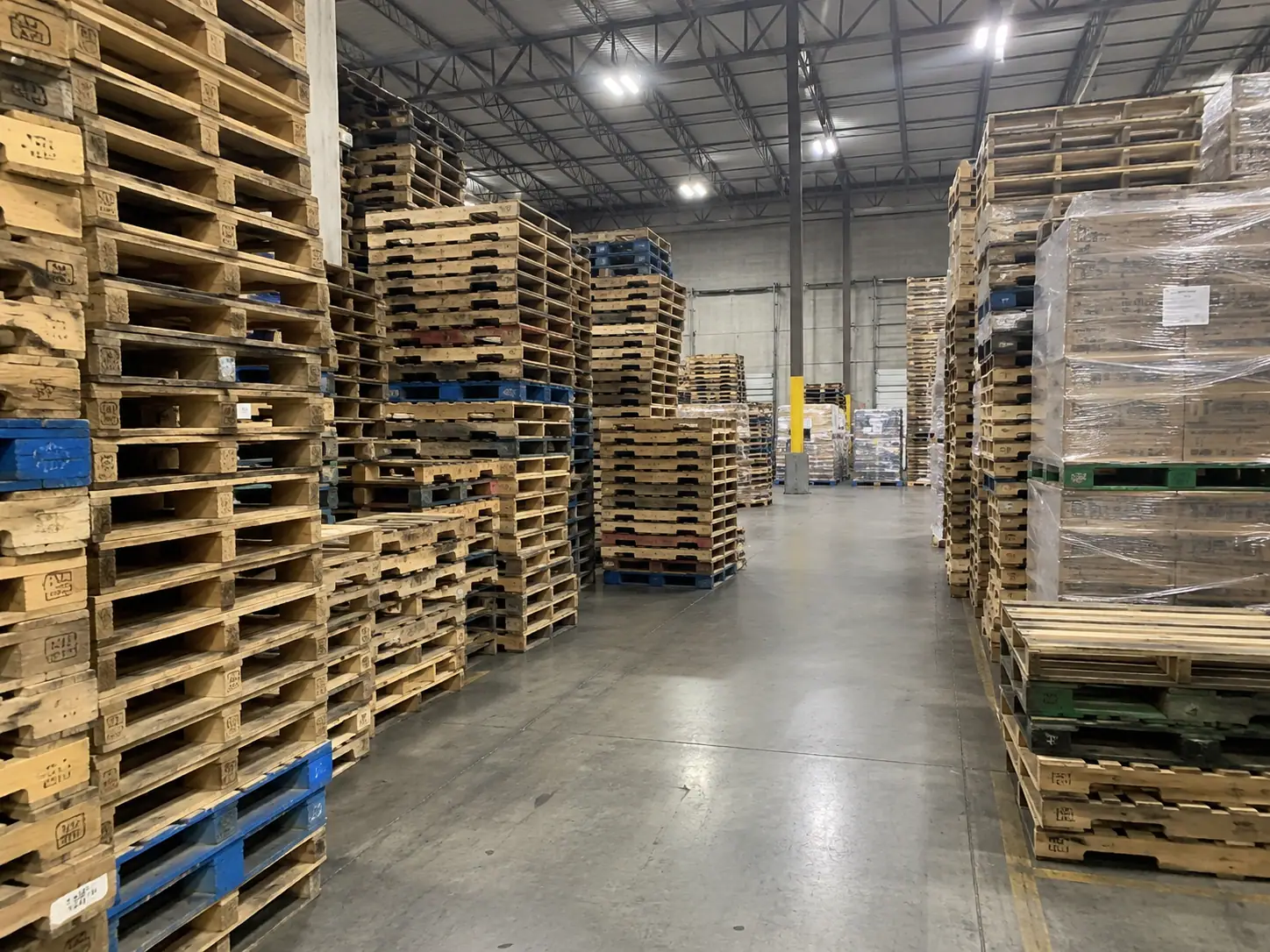
The sort aisle at half past seven. Graded stock on the left, waiting to be worked on the right.
- Backhaul
- Loading freight on the return leg of a trip that would otherwise run empty. The single most effective lever on pallet freight cost, and it has to be asked for — it does not happen automatically.
- Band (banding)
- Steel or polyester strapping around a stack of pallets. A banded stack of fifteen unloads in seconds; a loose pile takes an hour and costs about $0.35 a unit in handling.
- Block pallet
- A pallet built on nine (or sometimes six) solid wooden blocks rather than continuous stringers. Genuinely four-way accessible from every side. The standard construction in Europe — see Euro pallet.
- Board foot
- A unit of lumber volume: 144 cubic inches, or a piece 12″ × 12″ × 1″. A new 48×40 GMA pallet consumes roughly 24 board feet.
- Bottom deck
- The boards on the underside of a pallet. Their coverage determines how well the unit sits on rack beams; below roughly 40% coverage, racked capacity falls sharply.
- Buffer stock
- An agreed quantity held by a supplier against your call-offs. The standard cure for emergency spot purchasing, which at most sites is the largest avoidable pallet cost.
- Bulk bin
- A large container with a pallet base and fixed or collapsible walls, used for apples, castings and anything harvested or produced in volume. Collapsible versions fold flat for the return leg.
- Butted deck board
- Two short boards meeting end to end to make up a full run. A repair shortcut we do not permit — it fails under concentrated loads.
- Call-off
- A release against a committed volume. You agree a quantity and a price for a period, then draw it down as needed rather than ordering each time.
- Chamfer
- The bevelled edge cut on bottom deck boards so a pallet jack can ride up onto them without catching. Missing chamfers are a common cause of jack damage.
- Chime
- The reinforced rim at the end of a drum. Almost all of a full drum's weight lands on this ring, which is why four-drum loads behave nothing like a distributed load.
- Companion stringer
- A full-length stringer glued and nailed alongside a cracked one to restore its strength. A legitimate repair — but in our system it drops the unit to Grade B, because racked loads test stringer repairs hardest.
- Companion stringer
- A full-length stringer glued and nailed alongside a cracked one. A legitimate repair that in our grading drops the unit to B, because racked loads test stringer repairs first.
- Core
- Unsorted incoming used pallets, bought by the trailer or by weight and traded between processors. Raw material, not a shippable product.
- Cube out
- To fill the volume of a trailer before reaching its weight limit. Pallet loads always cube out — a full trailer of empties weighs about a third of legal payload.
- Deck board
- The horizontal boards forming the top and bottom surfaces. A standard GMA pallet has seven on top and three underneath.
- Deck coverage
- The proportion of a pallet's footprint occupied by deck boards. Bottom deck coverage below about 40% materially reduces racked capacity because beam contact area falls.
- Detention
- Time a driver spends waiting beyond the agreed window. Rarely invoiced separately on pallet freight and always reflected in the next quote.
- Display grade
- Grade A structure plus an appearance sort: uniform deck colour, no visible top-deck repairs, no stencils. Costs about a dollar a unit more and nobody supplies it unless asked.
- Diversion rate
- The share of incoming material, by weight, that leaves as a product rather than as waste. Ours is 99.4% — see the zero-waste promise.
- Drop trailer
- A trailer left on your yard to be filled or emptied at your own pace, then swapped. Removes dock-door waiting entirely and suits any site generating more than a trailer a fortnight.
- Dunnage
- Timber used to block, brace and separate freight inside a container or trailer. Covered by ISPM-15 and forgotten constantly, because it reads as offcuts rather than packaging.
- Dynamic load
- The weight a pallet can carry while being moved by handling equipment. Typically about half the static rating. See load capacity.
- EPAL
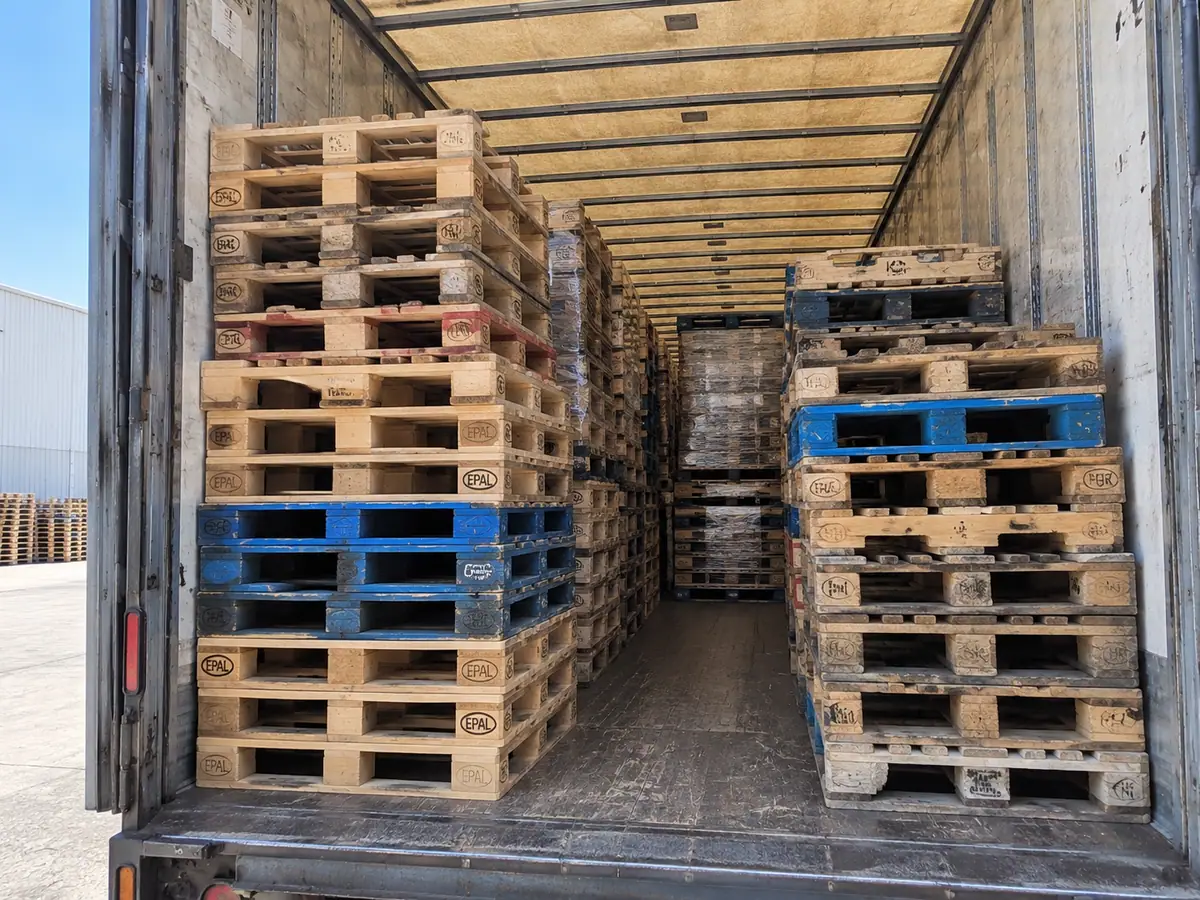
- The European Pallet Association, which licenses and controls the certification of Euro pallets. A genuine EPAL unit carries a branded oval, a licence number and a control staple after any certified repair.
- Equilibrium moisture content
- The moisture level wood settles at for a given temperature and humidity. It is why a stack can climb past 19% in a humid July without ever being rained on.
- Expendable pallet
- A pallet built or bought on the assumption it makes one trip and does not return. Specification is driven entirely by the cheapest thing that survives that trip.
- Expendable pallet
- A pallet specified on the assumption it makes one trip and does not return. Buying structural margin for an expendable load is money that stays on somebody else's site.
- FOB
- Free on board — a price excluding freight, usually meaning collection from the seller's yard. Comparing an FOB price against a delivered price compares nothing.
- Four-way
- A pallet that accepts forks from all four sides. Stringer pallets achieve partial four-way access through notches; block pallets are fully four-way by construction.
- GMA pallet
- The 48" × 40" specification originating with the Grocery Manufacturers Association: seven top deck boards, three bottom, three stringers, four-way notched. See 48 × 40 GMA.
- Grade A / #1
- In our system: all members original or replaced full-length, no stringer repairs, uniform appearance, under 19% moisture, square within a quarter inch. Definitions vary by supplier — see pallet grades.
- Grade B / #2
- Up to two replaced deck boards and one companion-repaired stringer permitted. Structurally sound, cosmetically used.
- Gross out
- To reach a vehicle's weight limit before filling its volume. The opposite of cubing out, and something pallet loads essentially never do.
- Hardwood
- Wood from broadleaf trees — oak, maple, poplar, gum, ash. Denser than softwood, better nail retention, heavier. The dominant material in North American recycled pallets.
- Heat treatment (HT)
- Heating wood to a core temperature of 56 °C for at least 30 continuous minutes to satisfy ISPM-15. Not the same as kiln drying. See ISPM-15 explained.
- Helical nail
- A spirally-threaded fastener that rotates as it drives, gripping far better than a smooth shank. The main reason some pallets stay square for years and others do not.
- IPPC mark
- The stamp certifying ISPM-15 treatment: wheat symbol, country code, facility number and treatment code, applied to at least two opposing sides.
- ISPM-15
- The international standard requiring treatment and marking of solid wood packaging moving across most borders. Exists to stop wood-boring insects travelling between continents.
- Kiln dried (KD)
- Wood dried in a kiln to reduce moisture content. A quality measure, not a phytosanitary treatment, and not accepted in place of an ISPM-15 mark.
- Lead board
- The outermost deck board at each end of a pallet, which takes the most abuse from forklift entry and is the most commonly replaced member.
- Live unload
- The driver waits while the trailer is unloaded. Faster overall for smaller loads; a drop trailer is better where dock doors are the constraint.
- Loss rate
- The proportion of pallets that leave and do not come back, per cycle. The variable that decides wood-versus-plastic and almost nobody has measured it.
- Methyl bromide (MB)
- A fumigant treatment for wood packaging, being phased out globally and refused by a growing list of countries. We exclude MB-marked material from our recycling stream entirely.
- Moisture meter
- A pin-type instrument measuring electrical resistance to estimate moisture content. Reads low on frozen wood, sometimes by several points, so take readings after a load has warmed.
- NANP
- The North American Numbering Plan. Relevant here only because our contact form validates phone numbers against it rather than accepting any ten digits.
- Nestable pallet
- A plastic pallet shaped so empties stack into each other, typically at about 4:1. Excellent for return logistics, not rated for racking, and confusing the two causes rack failures.
- Notch
- The cut-outs in a stringer's underside allowing fork entry from the sides. Standard notch is about 9" long and 1½" deep.
- Overhang
- Product extending past the pallet edge. Roughly a one-inch overhang can cost around 30% of a corrugated load's stack strength — a strong argument for getting the footprint right.
- Pallet jack
- A manual or powered truck that lifts a pallet from the bottom deck. Requires chamfered bottom boards and, on stringer pallets, entry from the two-way direction.
- Pinwheel
- A loading pattern alternating pallet orientation to fill a deck more completely. Worth two to eight units a trailer on common footprints — see the load planner.
- Plug
- A wooden insert filling a damaged area of a stringer. Permitted in Grade B in our system and not in Grade A.
- Pooling
- Renting pallets per trip from an operator who owns and manages the fleet. Compared honestly against ownership in pooling vs buying.
- Racked load
- The weight a pallet carries spanning unsupported between rack beams. Typically about a third of static capacity, and the number that matters if you rack anything.
- Reconditioned
- Used plastic pallets inspected, cleaned and resold, typically at 40 to 60% of new. Where the resin is sound this is by far the best value in plastic.
- Remanufactured
- A pallet rebuilt from recovered lumber, often cut down from a larger orphan footprint. Usually a five-board deck and Grade B load ratings.
- Reversible pallet
- A pallet with identical top and bottom decks, so either face can carry the load. Stronger but heavier, and it cannot be used with a pallet jack.
- Runner
- A longitudinal bearer under a skid or a block pallet, performing the job stringers do on a stringer pallet.
- Skid
- A platform with runners but no bottom deck. Cheaper and lighter than a pallet, slides on a floor, and cannot be handled by a pallet jack.
- Slip sheet
- A thin sheet of fibreboard or plastic used instead of a pallet, handled with a push-pull attachment. Saves weight and cube; requires specific equipment.
- Softwood
- Wood from coniferous trees — spruce, pine, fir. Lighter and cheaper than hardwood, with noticeably worse nail retention. Dominant in new pallet production.
- Sort deck
- The station where every incoming pallet is graded by hand into reuse, repair, dismantle or grind. Roughly two and a half seconds a unit, and about eight months to learn.
- Squareness
- Whether a pallet's diagonals are equal. More than a quarter inch of difference on a Grade A unit is out of tolerance, and out-of-square pallets are what jam racking.
- Static load
- The weight a pallet can carry resting on a flat, continuous surface. The highest of the three ratings and the least often relevant.
- Stringer
- The load-bearing members running the length of a pallet, usually three, typically 1⅜" × 3½". In a rack these act as beams, which is why cracks and repairs matter so much.
- Stringer pallet
- The dominant North American construction: three continuous boards running the length of the pallet, carrying the load, notched for partial four-way access.
- Tare
- The empty weight of a vehicle. Gross minus tare gives the net weight of a load, and every tonnage figure we publish traces back to that subtraction.
- Top cap / top frame
- A flat frame placed over a load before stretch wrapping to stabilise it and distribute the wrap tension. See accessories.
- Turned
- A pallet loaded ninety degrees from the usual orientation in a trailer. Mixing turned and straight rows is how a good loader fits more on a deck.
- Two-way pallet
- A stringer pallet without notches, accepting forks from only two opposing sides. Cheaper, and a nuisance if your operation assumes four-way access.
- Unit load
- The pallet plus everything on it, wrapped and secured — the thing that actually gets measured, moved and racked.
- Wing
- The overhang of a deck board past the outer stringers on a winged pallet, used to accept slings or bar handling. Rare in general distribution.
- Wire decking
- A mesh panel laid across rack beams to support a whole pallet rather than just its ends. Moves the load case back toward static and dramatically increases what marginal stock will carry.