Service 05 — Repair
Repair and remanufacturing: broken boards out, recovered boards in.
Price a repair program
Give us the quantity, the size and the ZIP. You'll get a written quote with the grade, the freight and the pickup window — not a sales call.
- Written quotes, usually inside one business day
- Loads from 100 pallets to full 53' trailers
- We buy as readily as we sell — tell us which way it flows
Inside the building
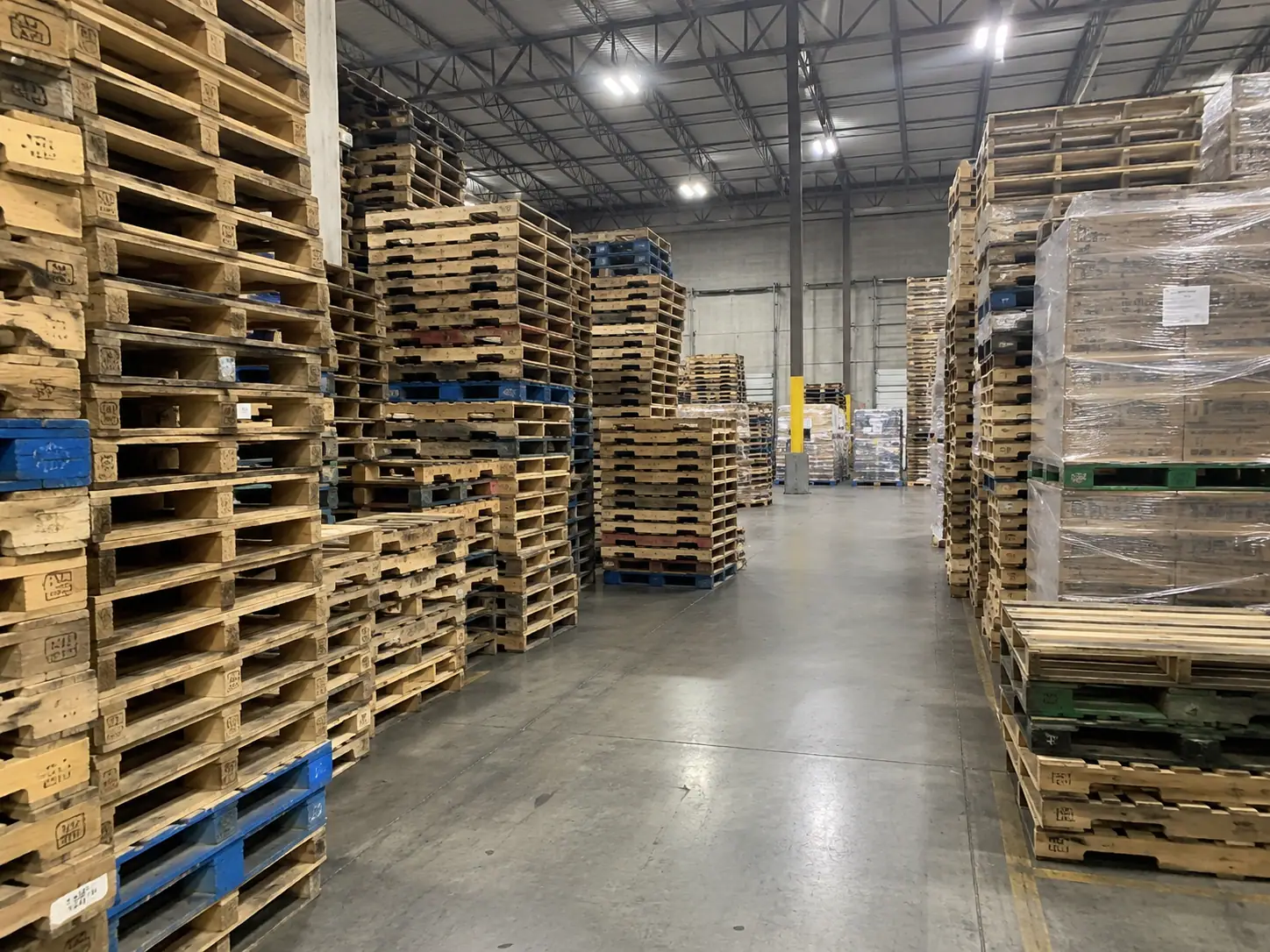
The sort aisle at half past seven. Graded stock on the left, waiting to be worked on the right.
Repair, properly done
What separates a repair from a bodge.
There is a version of pallet repair that involves nailing a short board across a break and calling it fixed. It passes a glance, fails a rack, and eventually drops product on a floor.
A proper repair replaces the full member. A broken deck board comes off entirely and is replaced with a full-length board of the same nominal thickness and a compatible species group. A cracked stringer either gets a full-length companion stringer glued and nailed along its face, or the unit gets dismantled — there is no third option that we consider acceptable.
Every repaired unit is re-graded after the fact, against the same published standard we use for everything else. A repaired pallet does not automatically come back as a Grade A; it comes back as whatever it now is.
- Full-member replacement only — no short splices across a break
- Companion stringers glued and nailed full length, or the unit is dismantled
- Same nominal thickness and compatible species group on every replacement
- Re-graded after repair, not before
- ISPM-15 units repaired only with heat-treated lumber, and re-stamped
Repaired to Grade A
The economics
When to repair, and when to stop
| Damage | Repair cost | Decision | Why |
|---|---|---|---|
| One broken deck board | $1.75 – $2.25 | Repair | Twenty minutes of a dismantler's time against a $9 unit |
| Two or three deck boards | $2.50 – $3.50 | Repair | Still well under half the replacement cost |
| Cracked stringer, one | $2.75 – $3.75 | Repair with companion | Structurally sound if done full length |
| Two or more cracked stringers | — | Dismantle | Repair cost exceeds unit value; the lumber is worth more |
| Wet or mouldy | — | Grind | Cannot be dried economically; grade is gone |
| Wrong footprint entirely | $3.50 – $6.00 | Remanufacture | Cut down to a standard size and rebuilt |
Remanufacturing
Turning an orphan size into something you can actually buy again
Remanufacturing is the deeper operation. A 52×42 unit that nobody stocks gets cut down to a 48×40 GMA footprint, rebuilt with recovered boards and re-decked. What arrives as an unsellable orphan leaves as the most liquid pallet in North America.
It is the right answer when you have inherited a footprint you no longer want — after an acquisition, a line change, or a customer switching their racking. Rather than scrapping the fleet, we convert it. The unit weight comes down slightly, the deck pattern is usually 5 boards rather than 7, and the load rating lands in Grade B territory, which we will tell you before you commit.
For anyone considering the opposite move — going custom rather than standard — read the custom sizing guide first. Non-standard footprints are a long-term cost that most operations underestimate.
Repair programs
Three ways customers use this
- 01Closed-loop repairYour pallets, your fleet. We collect damaged units, repair them and return the same population to you. Useful when the footprint is unusual or the pallets are branded.
- 02ExchangeYou send damaged units and receive an equivalent count of graded, ready-to-use stock immediately, with the repair happening on our clock instead of yours. Faster, marginally more expensive.
- 03Buy-repair-sellWe buy your damaged units outright, repair them, and sell them into the general market. Simplest arrangement; you take cash and walk away.
Questions
Repair questions
How many times can a pallet be repaired?
A well-built 48×40 GMA hardwood pallet typically survives five to eight service cycles with two or three repairs along the way before the nail holes stop holding and the unit goes to dismantling. Softwood and lighter-build units manage fewer.
Will a repaired pallet still be ISPM-15 compliant?
Only if the replacement lumber was itself heat-treated and the unit is re-marked correctly. This is one of the most common causes of held export shipments. We handle it properly, and we explain the rules in ISPM-15 explained.
Do repairs use new lumber?
Wherever the specification allows, no — we use lumber recovered from dismantled pallets, which is both cheaper and dramatically lower-carbon. Where a spec demands new material, we use new material and say so on the invoice.
Can you repair block and Euro pallets?
Yes, though EPAL-certified units carry their own repair rules, and a repair performed outside that scheme means the pallet can no longer travel as certified EPAL. We will always tell you before we touch one.
Repair standards
What we will and will not do to a damaged unit
| Situation | Our standard | Common alternative | Why it matters |
|---|---|---|---|
| Broken top deck board | Full-length replacement, matched thickness | Short board nailed across the break | A butted joint is a hinge under concentrated load |
| Cracked stringer | Full-length companion, glued and nailed | Short cleat over the crack | Bending stress is highest at mid-span, exactly where the cleat ends |
| Two cracked stringers | Dismantle — no repair | Repair both and sell on | Repair cost exceeds unit value and the result is unpredictable |
| Missing bottom board | Replace full length | Leave it | Bottom deck coverage governs racked capacity |
| Protruding fasteners | Set or remove every one | Ignore | Punctures film, cases and occasionally product |
| ISPM-15 marked unit | Treated lumber only, then re-mark | Repair with any lumber | This is the most common export compliance failure there is |
| Out of square by >¼″ | Re-square or downgrade | Ship it | Out-of-square units are what jam racking |
Running a repair loop
How a fleet stays alive instead of being replaced
Pull damaged units out before they fail, not after. The expensive version of pallet damage is discovering it when a load is already on a forklift. A five-second check at the point where empties are staged catches most of it and costs nothing.
Stage damaged units separately. A marked area, however small. Damaged pallets that go back into the good stack come out again as a product damage claim two months later.
Collect on a schedule rather than when the pile is embarrassing. Repair capacity is planned; a sudden trailer of damaged units competes with everyone else's booked work.
Decide your replacement threshold once and write it down. Two cracked stringers, or wet, or wrong footprint — those go to dismantling. Everything else is worth a look. Without a written rule, the threshold moves with whoever is on shift.
Track the repair rate. If the proportion of your fleet needing repair each year is climbing, something upstream changed: a new carrier, a new racking configuration, a new forklift operator. The pallets are telling you something.
What a repair buys
The numbers behind the decision
$2.75
Typical repair cost
Deck board replacement with recovered lumber.
3–5
Further cycles bought
Not a reset — the other members are the same age.
40%
Repaired with same-day lumber
Recovered from units dismantled that morning.
8
Maximum service cycles
For a well-built hardwood GMA, with repairs along the way.
Questions
More repair questions
Can we watch a repair being done?
Yes, and we would rather you did before signing a programme. Weekday mornings, hi-vis and closed-toe footwear. Seeing a bench for twenty minutes tells you more about a yard than any specification document.
Do you repair on site?
No. The economics depend on having a dismantling line feeding the bench, and that does not travel. What we do instead is collect, repair and return, or exchange for ready stock immediately.
What is exchange, exactly?
You hand over damaged units and receive an equivalent count of graded, ready-to-use stock on the same movement. The repair then happens on our clock rather than yours. Marginally more expensive per unit and dramatically faster.
Will repaired pallets be visibly different?
Yes. A replacement board is a different colour and weathering pattern from the ones around it. That is what an honest repair looks like, and if appearance matters — retail display — say so and we will sort for it.
Can you repair pallets built by someone else to a non-standard pattern?
Usually. Send photographs with a tape across the deck and the stringer face and we will tell you whether the members are available in recovered stock or need to be cut new.
You probably own more usable pallets than you think.
Send us the damage profile and a count. We will tell you what is worth repairing and what is worth dismantling — including when the answer is 'none of it'.
Keep reading
Repair & Remanufacturing is delivered from our yard at 7240 S Access Rd, Columbus, OH 43217, Monday to Friday 7:00 AM to 5:00 PM and Saturday mornings.