Not in the main menu · methodology
Every number we publish, and where it comes from.
Challenge one of these numbers
If you think a coefficient is wrong, tell us which one and why. We have changed two of them because customers argued convincingly.
- Written quotes, usually inside one business day
- Loads from 100 pallets to full 53' trailers
- We buy as readily as we sell — tell us which way it flows
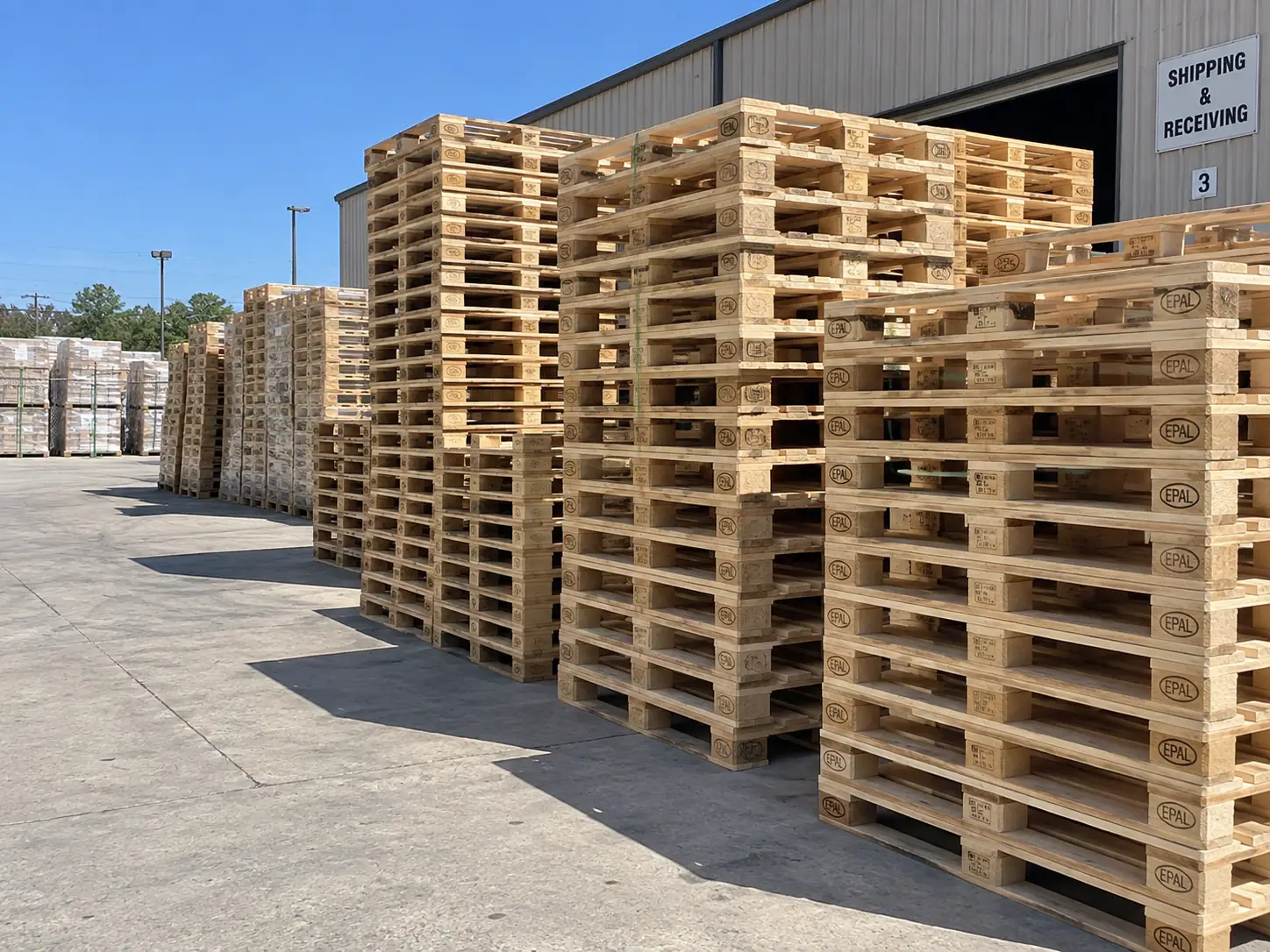
Outbound
Banded, counted and staged against the door. Stacks of fifteen, double-banded, the way a forklift expects them.
Life-cycle assessment for wood products is genuinely contested territory. Reasonable practitioners disagree about biogenic carbon accounting, about whether avoided landfill methane should be credited, and about how to allocate emissions between a pallet and the sawmill co-products it came from.
Rather than pick the interpretation most flattering to us, we have tried to do three things: draw a narrow, clearly-stated boundary; use the conservative end of any published range; and exclude the claims we cannot defend, even where the industry routinely makes them.
The result is a smaller number than we could justify with a looser method, and one we are willing to defend line by line.
The coefficients
Everything the Reclaim Index multiplies by.
| Coefficient | Value | Derivation | Confidence | If wrong, effect |
|---|---|---|---|---|
| New 48×40 pallet, cradle-to-gate | 16.6 kg CO₂e | Conservative end of published wood pallet LCAs, which cluster between 10 and 20 kg depending on species, drying method and transport distance | Medium | Directly scales the headline CO₂e figure |
| Recycled 48×40, collection to dispatch | 1.2 kg CO₂e | Our own 2025 diesel, electricity and gas consumption divided by units dispatched | Medium-high | Small — it is a minor term |
| Net avoided per reused unit | 15.4 kg CO₂e | 16.6 minus 1.2 | Medium | Headline figure |
| Board feet in a new 48×40 | 24 bf | Nominal dimensions of a standard GMA build: 7 top boards, 3 bottom, 3 stringers | High | Scales lumber and tree figures |
| Board feet per sawlog tree | 260 bf | Mid-range for a mature hardwood sawlog; the true range is roughly 150 to 500 | Low | Trees figure could be out by a factor of two either way |
| Weight, recycled 48×40 | 45 lb | Our scale data, 2025 average across all recycled GMA dispatched | High | Scales the landfill diversion tonnage |
| Passenger car, per mile | 0.36 kg CO₂e | Commonly cited average for a US passenger vehicle | Medium | Illustration only; not used in any reported figure |
| Carbon fraction of dry wood | ≈ 50% | Standard across forestry literature | High | Used only in explanatory text, not in calculations |
Boundaries
What is in, and what is deliberately out.
Included
- Collection freight from source to our yard
- Yard electricity, gas and equipment diesel
- Grinding, screening and colour-line energy
- Heat treatment fuel where applicable
- Avoided manufacture of the equivalent new pallet
- Avoided harvest, milling, drying and mill-to-market transport
Excluded
- Delivery from our yard to your site — it varies too much to generalise
- Use-phase emissions — effectively zero for a pallet
- End-of-life — the pallet is not at end of life when it leaves us
- Biogenic carbon storage in the wood itself
- Avoided landfill methane, which some methods credit heavily
- Any offset purchase, because we do not buy any
Where we think we are weakest
Three numbers we would not defend to the last decimal.
1. Trees spared
2. New pallet emissions
3. Our own yard emissions
Claims we refuse to make
Four things the industry says that we will not.
That mulch sequesters carbon
Ground wood spread on a garden bed decomposes over a few years and releases its carbon. Calling that sequestration is straightforwardly wrong, and it is said constantly.
That we are carbon neutral
We run diesel trucks and a grinder. We are not neutral, we have not bought offsets to claim that we are, and we would rather report the actual number.
That diversion is 100%
It is 99.4%. A company handling contaminated and treated wood that reports zero landfill is either refusing difficult material or not counting it.
That recycled pallets are 'carbon negative'
They are lower-carbon than the alternative. That is a comparative claim, and it is a strong one. Making it absolute would require accounting choices we do not think survive scrutiny.
Last reviewed January 2026. If you find an error in this page, tell us and we will correct it and note the change. Two coefficients on this page have already moved because customers argued convincingly — see the zero-waste promise for how the diversion figure itself is measured.
Questions
What sceptical readers ask about this method.
What boundary do these figures use?
Cradle-to-gate, and they measure emissions avoided rather than emissions produced. That covers everything from harvesting or collection through to the pallet leaving our yard. It excludes delivery to your site, use-phase, and end-of-life, and it makes no claim about carbon stored in the wood itself.
How is the headline 15.4 kg CO₂e derived?
16.6 minus 1.2. The 16.6 kg is a new 48×40 pallet cradle-to-gate, taken from the conservative end of published wood pallet LCAs, which cluster between 10 and 20 kg depending on species, drying method and transport distance. The 1.2 kg is our own 2025 diesel, electricity and gas consumption divided by units dispatched.
Which of your numbers is the weakest?
Board feet per tree, by a wide margin. We use 260 bf for a mature hardwood sawlog; the honest range is roughly 150 to 500, because a mature red oak on good ground yields very differently from a suppressed poplar. Treat any “trees spared” output as an illustration, not a measurement — it could be out by a factor of two either way.
Why exclude biogenic carbon storage and avoided landfill methane?
Because both are contested, both would flatter us, and neither is an accounting choice we think survives scrutiny. Some published methods credit avoided landfill methane heavily; we do not credit it at all. The same reasoning is why we will not call our mulch sequestration, or describe a recycled pallet as carbon negative.
What if I think one of these coefficients is wrong?
Tell us which one and why. Two coefficients on this page have already moved because customers argued convincingly, and if you find an error we will correct it and note the change. The page was last reviewed January 2026. How the 99.4% diversion figure itself is measured is set out in the zero-waste promise.