Industry
Pallets for chemical and industrial loads, where the failure mode is a spill.
Talk to us about chemical & industrial
Give us the quantity, the size and the ZIP. You'll get a written quote with the grade, the freight and the pickup window — not a sales call.
- Written quotes, usually inside one business day
- Loads from 100 pallets to full 53' trailers
- We buy as readily as we sell — tell us which way it flows
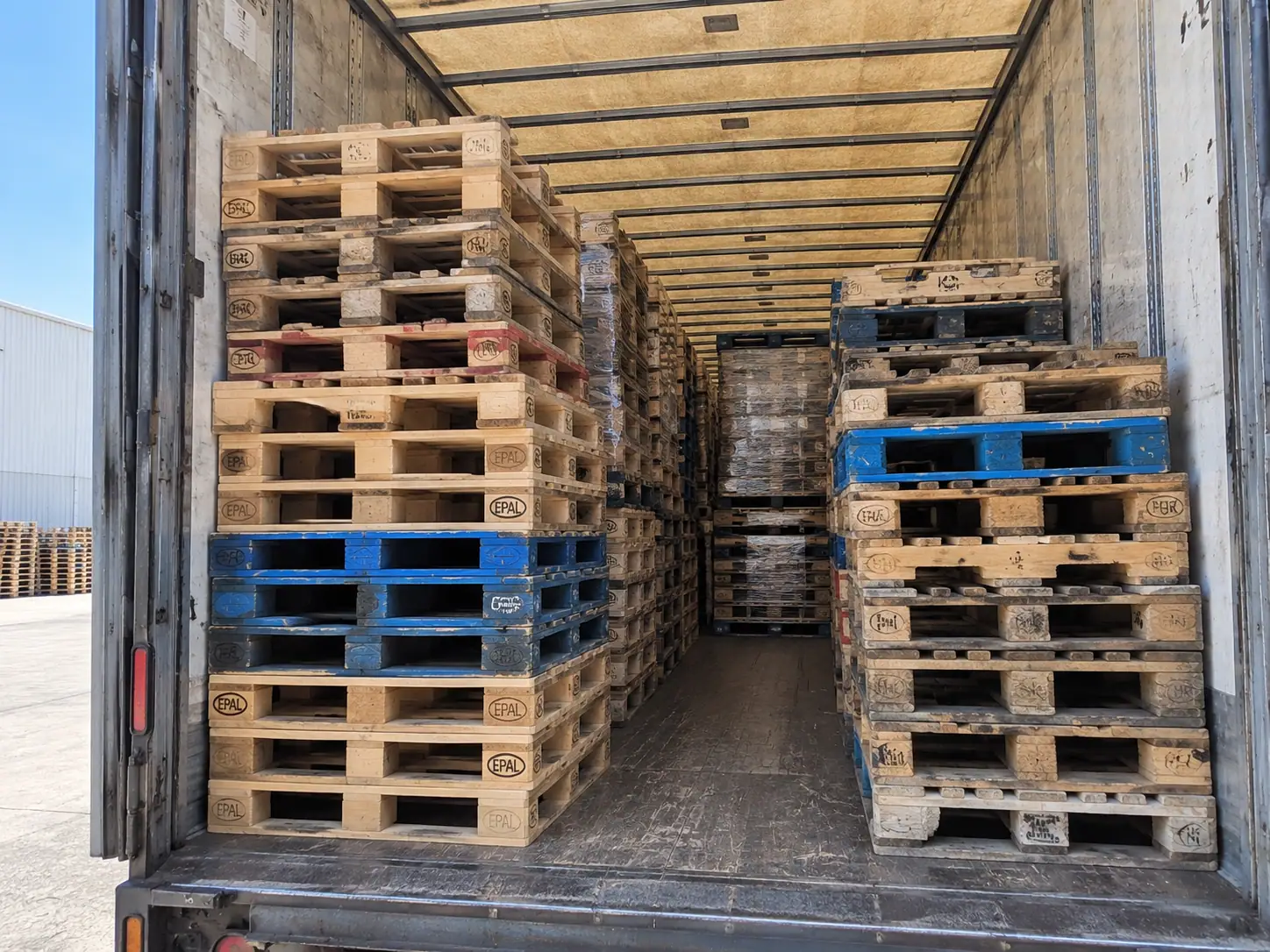
Loaded
About 330 units, two high, roughly 15,000 lb in a trailer rated for three times that. Pallet loads cube out long before they gross out.
The load case
Concentrated loads break pallets that carry distributed ones easily
A pallet rated to 3,000 lb dynamic is rated for a uniformly distributed load. Four 55-gallon drums do not distribute anything — they put roughly 480 lb each onto a chime ring about 22 inches across, and the deck between those rings does very little work.
That is why drum pallets are built differently: thicker deck boards, closer spacing under the drum footprints, and frequently four stringers rather than three. A standard-build 48 × 48 will hold four drums on a floor and then deflect alarmingly in a rack.
If your drums go into racking, say so. It changes which units we pull, and the difference is roughly a dollar fifty against the cost of a drum coming off a beam.
Handling returns
What we will and will not take back
- 01Clean emptiesPallets that carried sealed containers with no leakage. Normal collection, normal grading, normal payment.
- 02Stained or residue-markedSegregated on arrival, kept out of the food and display streams entirely, and either dedicated to industrial reuse or ground into boiler fibre rather than landscape mulch.
- 03Known contaminatedWe will not take it. It goes to a permitted disposal facility, and we will tell you which ones we work with. This is part of the 0.6% we openly report as landfilled.
- 04Methyl bromide markedExcluded from our stream entirely, regardless of condition. See ISPM-15 explained.
Questions
Chemical and industrial questions
Which footprint for 55-gallon drums?
Do you offer spill containment pallets?
We source them but we do not build them — containment units are moulded polyethylene with a sump, and that is a manufactured product rather than a carpentry one. Ask and we will point you at a supplier.
Can we get heat-treated stock for export?
Yes. Chemical export is one of the lanes where ISPM-15 compliance gets checked most carefully. See heat-treated pallets.
How do you handle our documentation requirements?
Weight tickets per collection, segregation records for stained returns, and disposal documentation for anything that leaves the recycling stream. Tell us what your EHS team needs and we will match it.
Drum loading
Which footprint for which drum arrangement
| Arrangement | Footprint | Approx. loaded weight | Deck requirement | Notes |
|---|---|---|---|---|
| Two 55-gal drums | 48″ × 40″ GMA | ≈ 1,000 lb | Standard Grade A | Centre the pair over the stringers |
| Four 55-gal drums | 48″ × 48″ | ≈ 2,000 lb | Heavy deck, 4 stringers preferred | The standard four-drum footprint |
| Four 55-gal drums, tight | 42″ × 42″ | ≈ 2,000 lb | Heavy deck | Minimal clearance for strapping |
| Four 30-gal drums | 42″ × 42″ | ≈ 1,100 lb | Grade A | Comfortable clearance |
| One IBC tote | 48″ × 40″ or 48″ × 48″ | ≈ 2,900 lb | Purpose-built or steel base | Usually supplied with the tote |
| Mixed pails and small containers | 48″ × 40″ | Varies | Grade A, tight deck gaps | Gap under 3″ to stop pails dropping |
Segregation
Handling returns from a chemical site properly
- 01Segregate at your end, not oursClean empties in one place, stained or residue-marked units in another. Sorting on your dock costs minutes; sorting on ours costs the value of the load.
- 02Tell us about a spill even if it looks cleanWood absorbs. A pallet that was under a leak and has dried looks fine and is not. We would far rather know at quote stage.
- 03Keep MB-stamped units out entirelyMethyl-bromide-treated wood is excluded from our stream regardless of condition. The stamp decoder shows where to look.
- 04Never mix drum pallets into a food-sector streamIf your site handles both, the two populations must be physically separate. This is the single most important control in a mixed operation.
- 05Ask for the disposal documentationAnything we route to permitted disposal generates a record. Your EHS team will want it, and asking after the fact is harder than asking upfront.
Concentrated loads
Why published ratings mislead in this sector
Every published pallet rating assumes a uniformly distributed load. A chemical operation almost never has one.
A 55-gallon drum puts nearly all its weight onto a chime ring roughly 22 inches across. Four of them is four rings pressing into a deck, with the area between them doing very little work. The deck boards under the rings are in bending across a short span with a concentrated line load, which is a completely different problem from a pallet of cartons.
A practical rule: halve the published racked capacity for a four-drum load. That is not conservatism for its own sake — it is an acknowledgement that the rating was measured under conditions your load does not resemble.
The construction response is thicker deck boards, tighter board spacing beneath the drum positions, and frequently four stringers rather than three. Ask for it specifically; standard-build stock in the same footprint will hold the weight on a floor and deflect alarmingly in a rack.
Questions
More chemical and industrial questions
Do you supply spill containment pallets?
We source them rather than build them — containment units are moulded polyethylene with a sump, which is a manufactured product rather than a carpentry one. Ask and we will point you at a supplier.
Can wood pallets be used with corrosive materials?
Commonly, yes, with the product in appropriate containers. The pallet is not the containment; the drum is. What matters is that a leak has somewhere to go and that the pallet is treated as contaminated afterwards.
What documentation do you provide for EHS?
Weight tickets per collection, segregation records for stained returns, and disposal documentation for anything leaving the recycling stream. Tell us what your team needs and we will match the format.
Are heavier pallets always the answer?
No — weight is a proxy for construction, not a substitute for it. A heavy pallet with wide deck gaps under the drum positions is worse than a lighter one with correct spacing. Specify the construction, not the weight.
Do you take pallets from petroleum sites?
Clean empties yes, on a segregated stream that never enters the food or landscape product lines. Known contaminated material goes to permitted disposal and we will tell you which facility.