56 answers
Everything we get asked, answered without the run-up.
Ask something not on this page
Put the question in the message field. We answer by email, usually the same day.
- Written quotes, usually inside one business day
- Loads from 100 pallets to full 53' trailers
- We buy as readily as we sell — tell us which way it flows
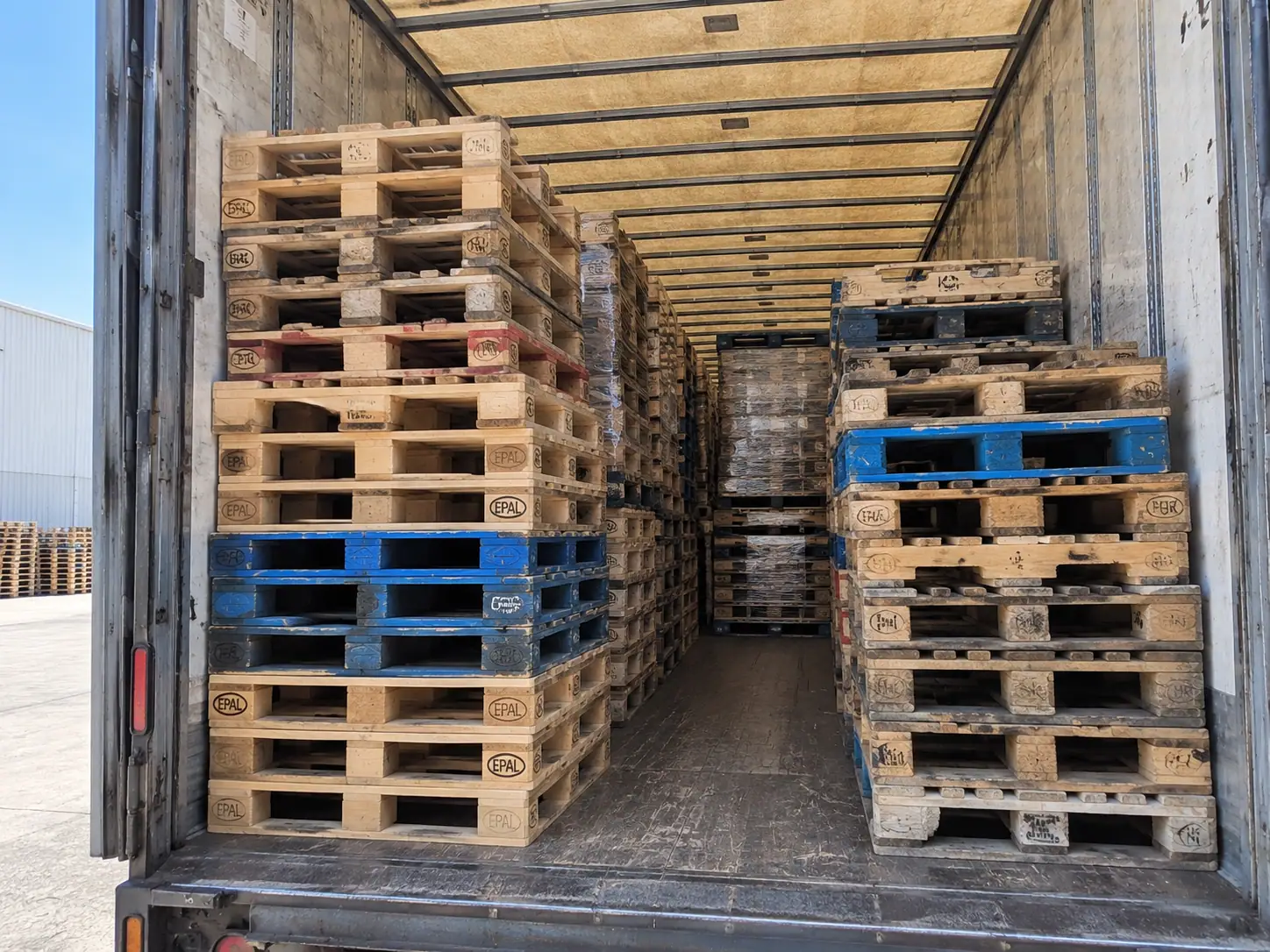
Loaded
About 330 units, two high, roughly 15,000 lb in a trailer rated for three times that. Pallet loads cube out long before they gross out.
Section 01
Buying
How much does a used pallet cost?
In central Ohio through 2025, recycled 48×40 GMA has moved roughly $7.50 to $12.00 for Grade A and $5.00 to $8.50 for Grade B, before freight. New equivalents ran $17 to $22. Prices move with lumber futures, diesel and season — spring and autumn are tight, January is soft. See buy used pallets.
What is your minimum order?
100 pallets for pickup from our yard, or a partial trailer of around 260 units for delivery. Below that, freight starts to cost more than the pallets. Ask anyway — we sometimes have a truck already routed your way.
Can I inspect before I commit?
Yes, and we would rather you did. Come to the yard, pull ten units off a stack at random and grade them yourself against our published standard. Most disputes in this trade come from people buying sight unseen.
What if a load does not match the grade?
Tell us within five business days with photographs and we will replace the shortfall or credit it, your choice. We would rather eat a load than argue about one.
Do you quote delivered or FOB?
Delivered by default, because that is the number that determines whether the deal works. We will quote FOB our yard if you have your own freight — sometimes yours is cheaper and we would rather you used it.
How quickly can you supply?
48×40 GMA in Grade A or B, same or next day in Columbus. Specialty footprints, two to seven days. New builds, about two weeks. Custom prototypes, three to five business days.
Do you sell to brokers?
Yes, at the same pricing structure as end users. We will not quote a grade we cannot supply in order to win a bid, which occasionally makes us the second-cheapest number on a sheet.
Section 02
Selling and collection
Do you actually pay for used pallets?
For whole, repairable cores, yes — through 2025 that has ranged from about $1.50 to $6.00 per unit depending on condition, volume and distance. Broken, wet or odd-size loads usually move on a removal fee instead. See sell your pallets.
How many pallets before a pickup is worth it?
Around 200 units makes the freight stand on its own. Below that we can often add you to an existing route.
What does removal cost?
Typically $95 to $180 per trailer load in central Ohio for material with no resale value — well below landfill tipping plus your own freight, and it still gets recycled rather than buried.
How fast can you collect?
For a scheduled customer, your slot. For a new site in central Ohio, usually within three business days. Emergencies we will do what we can, and we will say honestly if we cannot.
Do we have to sort the pile first?
No, but it changes the price substantially. Separating whole 48×40 cores from everything else routinely adds 20 to 30% to a load's value. Full method in how to sell used pallets.
Will you take branded or coloured pallets?
We segregate them and return them into the pool network rather than reselling them. They are almost always the property of a pooling company and not yours to sell — see pooling vs buying.
What about the nails and banding?
We handle it. Ferrous metal is separated magnetically during grinding and sold as scrap. It is not a reason to hold up a load.
Can you provide documentation for waste reporting?
Yes. Weight ticket per collection plus a monthly diversion statement showing tonnage by outcome. See the zero-waste promise.
Section 03
Grades and specification
What is the difference between Grade A and Grade B?
In our system, Grade A has all members original or replaced full-length and permits no stringer repairs at all. Grade B allows up to two replaced deck boards and one companion-repaired stringer. Racked capacity is roughly 2,100 lb against 1,500 lb. Full comparison in Grade A vs Grade B.
Is there an official grading standard?
No. There is no certifying authority and no legal definition in North America. Grade A means what each supplier says it means, which is why we publish our criteria in full.
Are recycled pallets strong enough for racking?
A Grade A recycled 48×40 carries about 2,100 lb racked and 3,000 lb dynamic. What matters more than new-versus-recycled is deck board thickness, stringer species and repair method — and we tell you all three.
What is the standard pallet size?
48 inches by 40 inches in North America — the GMA footprint, 1219 × 1016 mm. In Europe it is the 1200 × 800 mm Euro pallet. See the size library.
How tall is a standard pallet?
5½ inches for a GMA stringer pallet; 144 mm for a Euro block pallet.
What do static, dynamic and racked mean?
Static is what a pallet holds on a flat floor. Dynamic is what it holds while being moved. Racked is what it holds spanning unsupported between beams — typically about a third of the static figure, and the number that matters if you rack. Full explanation in load capacity.
How many pallets fit on a 53-foot trailer?
Twenty-six 48×40 units on the floor, or about 330 stacked two high in stacks of 15. The size library calculates this for any footprint.
What is a remanufactured pallet?
One rebuilt from recovered lumber, usually with a five-board deck rather than seven, often cut down from a larger orphan footprint. Sound, light, visibly rebuilt, and priced accordingly.
Section 04
Compliance and export
Do I need heat-treated pallets?
For international shipments of solid wood packaging, almost always. For domestic shipping, no — and paying for it is money wasted. See ISPM-15 explained.
What does the IPPC stamp mean?
It carries the wheat symbol, an ISO country code, a facility registration number and a treatment code — HT for heat treatment, DH for dielectric, MB for methyl bromide. It must be legible and on at least two opposing sides.
Can a repair invalidate ISPM-15 compliance?
Yes, and it is the most common cause of held shipments. Any replacement component on a marked pallet must itself be heat treated and the unit re-marked.
Is kiln dried the same as heat treated?
No. They are different processes with different requirements, and a KD stamp will not clear customs.
Are plastic pallets exempt?
Yes — ISPM-15 covers solid wood only. On high-frequency export lanes that is sometimes the cheaper answer overall. See plastic pallets.
Are wooden pallets acceptable under FSMA?
FSMA does not prohibit them; it requires you to identify and control hazards. For most food operations, controlled sourcing plus moisture and odour discipline is a defensible control. See food and beverage.
Section 05
Locations & coverage
Which states do you actually cover?
All fifty, at four different service levels. Ohio is our home yard; Indiana, Kentucky, Michigan, Pennsylvania and West Virginia are served on our own trailers on fixed lanes; anywhere within about 700 miles is scheduled contract freight; beyond that we are a specification and project supplier rather than a routine one. Every state has its own page under locations.
Why do you tell people to buy from someone else?
Because pallets are cheap, bulky and heavy, and a yard forty miles away at a higher unit price beats one three hundred miles away at a lower one, every time. Quoting a number that only works on paper wastes a week of your time and none of ours.
Do you have city-level information?
301 city pages, each with the local freight corridors, the industry mix and what that means for the pallet specification. Start from your state page.
What is the difference between locations and service area?
Service area is the lanes our own trailers run, with days and schedules. Locations is the national picture including everywhere we do not run trailers.
Can you ship a custom build anywhere in the country?
Yes. Custom and engineered work is quoted from a drawing and shipped as project freight, and the distance economics are completely different from routine stock supply.
Do you work with brokers outside your region?
Regularly. Brokers get the same pricing structure as end users, and the same refusal to quote a grade we cannot supply in order to win a bid.
Section 06
Tools & specification help
Do I have to give you an email to use the calculators?
No. None of the six tools are gated and nothing you type into them leaves your browser. A calculator behind an email wall is a lead form wearing a costume.
How do I work out how many pallets fit on a trailer?
Use the load planner. It tries every mixed orientation — some rows straight, some turned — and draws the arrangement that fits the most, which is usually two to eight units more than a single-orientation calculation.
How do I know which grade to buy?
The grade selector walks five questions and gives you a specific grade, footprint and price band with the reasoning attached. The short version is that it depends on whether the pallet comes back and whether it racks.
Can you help us work out what pallets really cost us?
Yes, free. Send twelve months of purchase and removal invoices and we will build the real number, whether or not you go any further with us. Or model it yourself with the cost calculator.
How do I read the stamp on a pallet?
The stamp decoder redraws the IPPC mark from the codes you can see and explains each element, including which treatment codes are increasingly refused.
Do you publish your grading criteria?
In full, on the pallet grades page and the Grade A specification sheet. It is the internal document our sort deck grades against, not a marketing summary.
Section 07
Working with us
How do I open an account?
Send a request through the form. Standard terms are net 30 for account customers after the first two orders settle; new customers pay before dispatch. We do not run credit checks on small orders — the first two transactions tell us what we need.
What is your quote turnaround?
Same business day for anything received before about 3:00 PM, next morning otherwise. If a request needs a yard check we acknowledge immediately and come back with the answer.
How long is a quote valid?
Fourteen days unless the quote says otherwise. Lumber, diesel and core markets move, and a price from six weeks ago is not one we can hold.
What happens if a load does not match the grade?
Tell us within five business days with photographs of the units in question and we replace the shortfall or credit it, your choice. We do not argue about it — the occasional replaced load costs less than a reputation for arguing.
Can we visit before ordering?
We would rather you did. Come to the yard, pull ten units off a stack at random and grade them yourself against our published criteria. Most of our long-term customers did exactly that first.
Do you have minimum order quantities?
100 pallets for yard pickup, around 260 for a delivered partial trailer, 250 units for a custom or new build production run. Below those, freight or setup dominates and we will say so.
Will you sign our supplier agreement?
Usually. Send it. We will flag anything we cannot honestly commit to rather than signing and hoping, which is more common in this trade than it should be.
Do you have a sustainability report we can cite?
The numbers are published continuously rather than annually: zero-waste promise for measured diversion, carbon methodology for modelled figures, and a year-end account in the journal including what went wrong.
Section 08
Sustainability and operations
What is your landfill diversion rate?
99.4% by weight across 2025 intake. The residual 0.6% is treated and contaminated wood we are not permitted to process, and we publish it because a claimed 100% should worry you.
How much carbon does a recycled pallet save?
Roughly 15.4 kg CO₂e and 24 board feet of lumber against buying new, for a 48×40. Every coefficient is published on the carbon methodology page.
What is a Pallet Passport?
A per-shipment record showing collection region, grade issued, the share of wood reused, repaired and remilled, and what the load diverted. Free on request. See Pallet Passport.
How far do you deliver?
About 350 miles on our own trailers, across Ohio, Indiana, Kentucky, Michigan, Pennsylvania and West Virginia. Further on contract carriers, though past about 500 miles we will usually point you at a closer yard. See the service area.
Can you hold stock for us?
Yes, under a managed program. A buffer is the single most effective way to eliminate emergency spot purchases, which at most sites is the largest avoidable pallet cost.
Why is there no phone number on this website?
Because we quote in writing. Every number you get from us — price, grade, freight, pickup window — arrives by email so you have it on record and can compare it properly. It also means nobody is chasing you with a sales call.
Can we visit the yard?
Yes. Weekday mornings are best. Hi-vis and closed-toe footwear required, and we have spares. See the yard and crew.