Technical guide · 9 min read
Pallet load capacity: static, dynamic and racked.
Last reviewed January 2026 · Written by the RePallet USA yard team
Ask us about anything on this page
These guides are written by the people who grade the pallets. If something here does not match your situation, tell us in the message field.
- Written quotes, usually inside one business day
- Loads from 100 pallets to full 53' trailers
- We buy as readily as we sell — tell us which way it flows
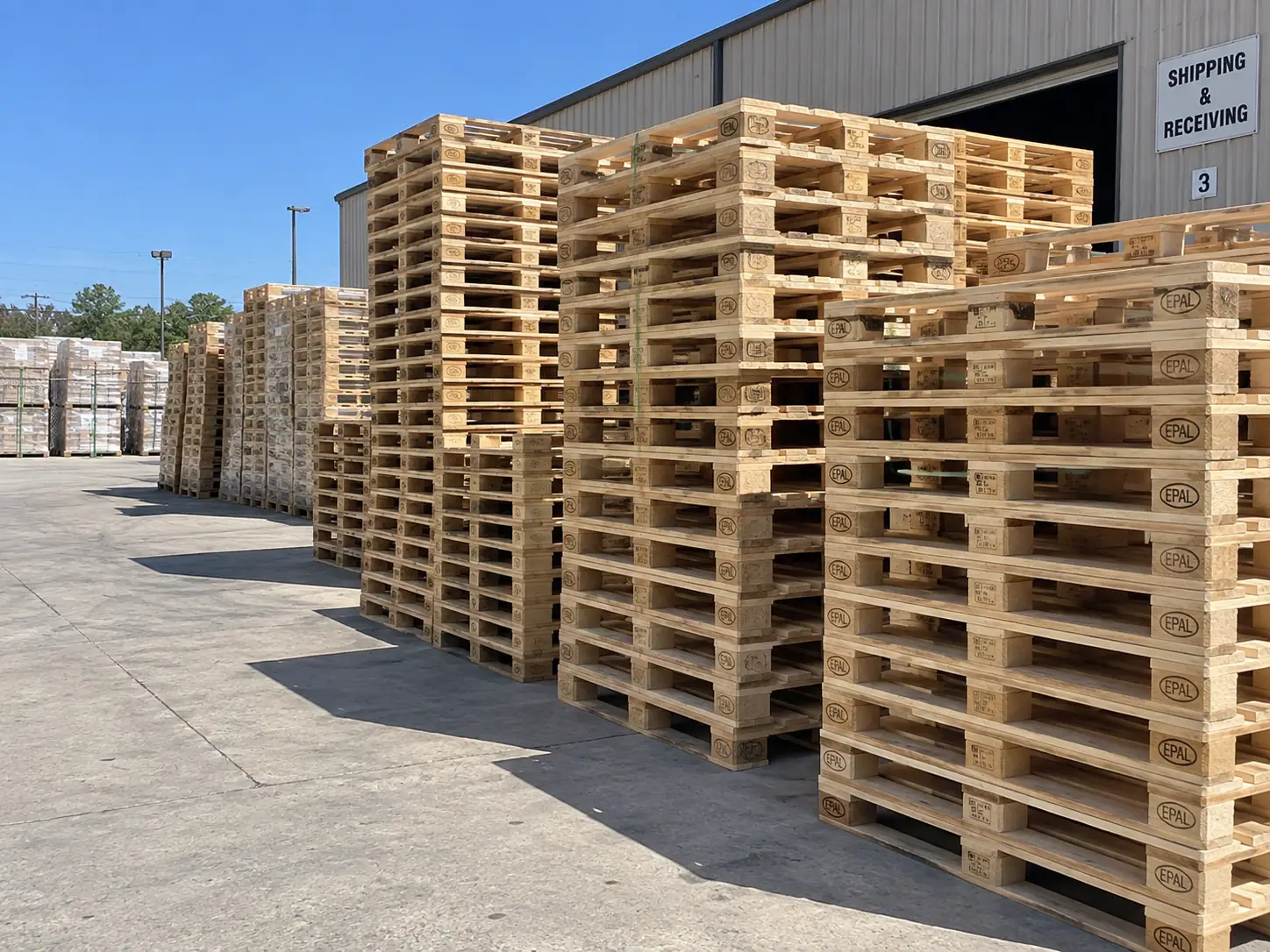
Outbound
Banded, counted and staged against the door. Stacks of fifteen, double-banded, the way a forklift expects them.
The three numbers
What each rating means, and a typical 48 × 40 figure
| Rating | The load case | Typical Grade A recycled | When it governs |
|---|---|---|---|
| Static | Resting on a flat, continuous surface | ≈ 6,000 lb | Floor stacking, staging |
| Dynamic | Being lifted and moved by equipment | ≈ 3,000 lb | Any handling |
| Racked | Spanning unsupported between two beams | ≈ 2,100 lb | Racked storage — the demanding case |
Why racked is so much lower
It is a beam problem, not a strength problem
On a floor, a pallet's deck is fully supported: the load presses down and the floor pushes back everywhere. Nothing bends. The limit is compression of the wood itself, which is high.
In a rack, the pallet spans between two beams with nothing underneath the middle. Now the stringers are beams, and beams fail in bending. Bending stiffness scales with the cube of depth, so a stringer half an inch shallower is dramatically weaker — and a stringer with a crack or a repair has a discontinuity exactly where the bending stress is highest.
This is why we do not permit repaired stringers in Grade A, and why the difference between a Grade A and Grade B pallet is far larger in a rack than on a floor.
What changes the numbers
Five variables that matter more than 'new or recycled'
- 01Deck board thickness9/16-inch hardwood is standard. 5/16-inch appears on budget new pallets and is dramatically weaker under a concentrated load. Always ask.
- 02Stringer depth and speciesBending stiffness goes with depth cubed. A 3½-inch hardwood stringer and a 3-inch softwood one are not remotely comparable.
- 03Load distributionRatings assume a uniform load. Four drums, a single machine, or a load on a small footprint concentrate force and can halve the effective capacity.
- 04Support orientationEdge-supported across the stringers is the standard racked case. Racked the other way, with the deck boards spanning, capacity collapses. This is a real and common error.
- 05Moisture contentWood loses stiffness as it takes up moisture. A pallet at 25% moisture is measurably weaker than the same pallet at 15%.
Practical advice
How to specify without over-engineering.
Start with the actual load, weighed, not estimated from a bill of materials. Then apply the load case that genuinely occurs — if the pallet is racked once in its life, that is the governing case regardless of how rare it is.
Then apply a margin. Two to one on the racked figure is conventional and reasonable for general distribution; less than that and you are relying on every unit being perfect, which they will not be by their third cycle.
And check the orientation in your racking. It is free, it takes five minutes, and getting it wrong is one of the more common causes of rack incidents involving pallets.
- Weigh the load; do not estimate it
- Use the racked figure if racking ever happens
- Apply roughly a 2:1 margin on racked capacity
- Verify pallets are loaded across the stringers, not along the deck boards
- Derate for concentrated loads — drums, machinery, single heavy items
Stringers span the beams
Questions
Load capacity questions
Where do these ratings come from?
Testing to ISO 8611 or equivalent, or from published industry data for standard constructions. Recycled stock is not individually tested — figures are indicative for a sound unit of that build.
Can I get a tested rating?
For new builds, yes, through a partner laboratory. For recycled stock, no meaningfully — the variability between units makes a certificate misleading. If you need a documented rating, buy new.
Does stacking pallets change the rating?
Yes. A stacked pallet is bearing on the pallet below rather than on a floor, and load transfer depends on alignment. Column-stacked and aligned is far better than pinwheeled.
What about wire-decked racking?
Wire decking supports the whole pallet, which moves the load case back toward static and substantially increases what the pallet will carry. It is a good investment for anyone racking marginal stock.
Why does a repaired stringer matter so much more in racking than on the floor?
Because in a rack the stringers are working as beams, and beams fail in bending. A repair or a crack is a discontinuity in the member, and it usually sits close to mid-span, which is exactly where the bending stress is highest. On a floor the deck is fully supported and nothing bends, so the same repair barely registers — which is why two pallets can look interchangeable right up until the day they go into racking.
Tell us the load and where it sits.
Weight, distribution and whether it racks. That is enough for us to tell you which grade you need, and often to tell you that you are over-specifying.