Industry
Pallets for food and beverage, where the pallet is part of the audit trail.
Talk to us about food & beverage
Give us the quantity, the size and the ZIP. You'll get a written quote with the grade, the freight and the pickup window — not a sales call.
- Written quotes, usually inside one business day
- Loads from 100 pallets to full 53' trailers
- We buy as readily as we sell — tell us which way it flows
Outbound
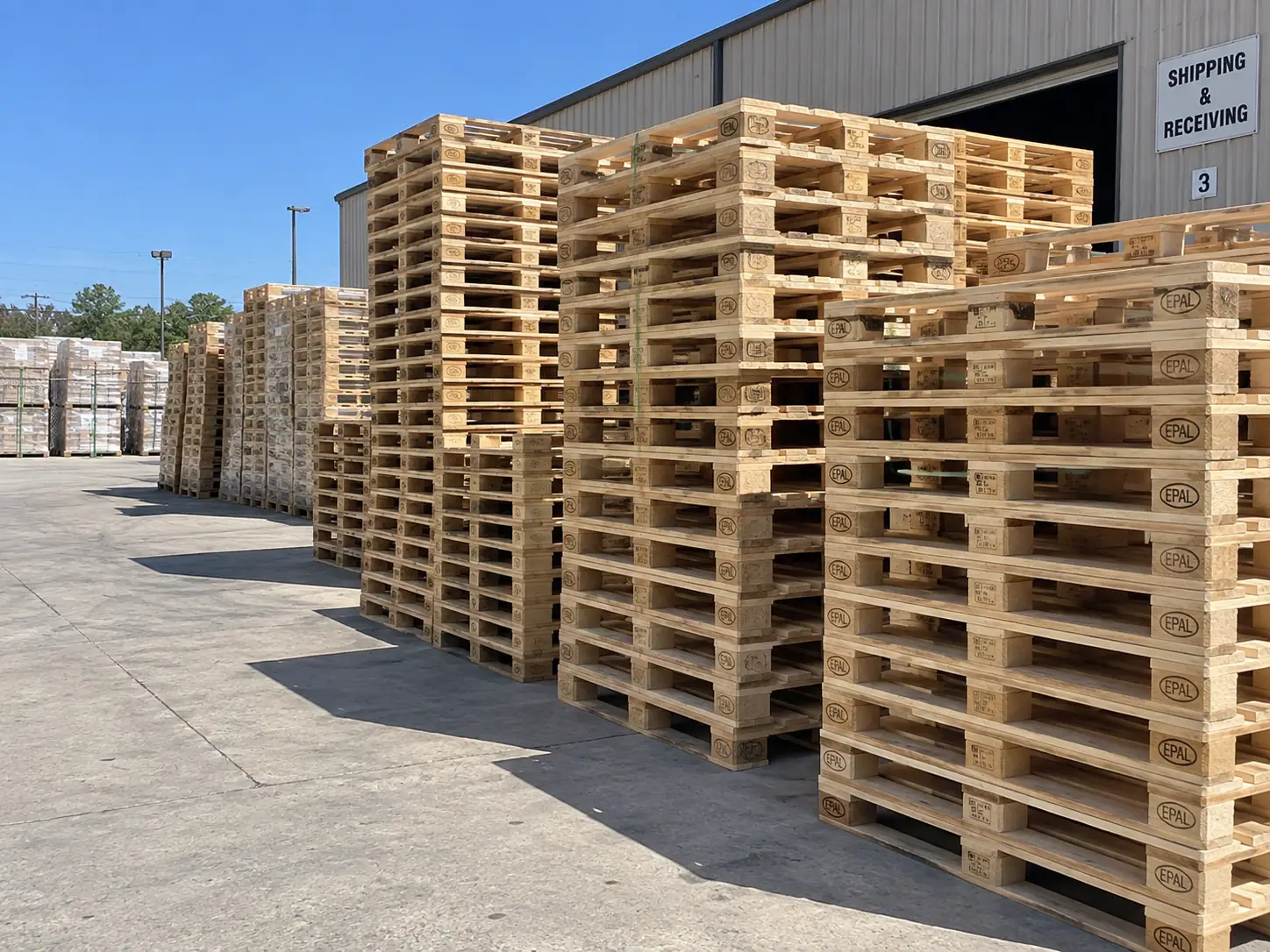
Banded, counted and staged against the door. Stacks of fifteen, double-banded, the way a forklift expects them.
What actually matters
The five things a food auditor asks about a pallet
- 01Where did it come from?Not the vendor — the previous life. A pallet that carried drums of solvent has no business under a bakery case, and 'we buy from a recycler' is not an answer. We track collection region and source sector and will tell you both.
- 02Is it dry?Wood above about 19% moisture supports mould growth, and mould under stretch wrap becomes visible in days. Every unit is meter-checked before dispatch.
- 03Does it smell?Odour transfer into packaging and product is real, and it is the most common cause of a rejected load in this sector. Any unit with a detectable chemical odour is pulled at the sort deck.
- 04Are there protruding fasteners?A nail standing proud punctures film, cases and, occasionally, primary packaging. Zero tolerance, and it is checked at the cleaning station.
- 05Can you prove any of this?Collection records, grade certificates and, for programme customers, a per-load Pallet Passport. Paper an auditor will actually accept.
The honest position
Wood is not sterile, and nobody should claim it is.
Wood is porous, organic and impossible to sanitise in the way a plastic surface can be. Anyone selling you 'sanitised' wood pallets is overselling. What wood can be is clean, dry, odour-free and of known provenance — and for the overwhelming majority of food operations, that is exactly what the hazard analysis calls for.
Where the hazard analysis calls for more — direct product contact, wash-down zones, high-care areas — the correct answer is plastic, and we will tell you so even though it is not the product we would rather sell you.
- Grade A stock, appearance-sorted, from food-sector collection routes
- Moisture verified under 19% at three points before dispatch
- Odour and staining rejection at the sort deck
- Heat treatment available where an export lane requires it
- Plastic recommended without argument for wash-down and high-care zones
Questions
Food and beverage questions
Are wooden pallets allowed under FSMA?
Yes. FSMA does not prohibit wood pallets; it requires that you identify and control hazards. For most operations, controlled sourcing plus moisture and odour discipline is a defensible control. Your hazard analysis governs, not a blanket rule.
Do you supply pallets for cold storage?
Yes, and moisture matters even more there. Wood that goes into a freezer wet stays wet and frosts. We dispatch cold-chain stock at the dry end of our range and recommend indoor staging before use.
Can we get pallets from a single, named source?
For programme customers with sufficient volume, yes — we can run a dedicated collection loop so your stock originates only from sources you have approved. It costs more and it is occasionally worth it.
What about pest control and ISPM-15?
Domestically, ISPM-15 is irrelevant. For export, it is mandatory and it is easy to invalidate through repair. See ISPM-15 explained.
Zone by zone
What belongs where in a food plant
| Zone | Material | Grade / format | Why |
|---|---|---|---|
| High-care / open product | Plastic, hygienic | Smooth or open deck | Cleanable, non-absorbent, no fasteners |
| Wash-down areas | Plastic | Hygienic HDPE | Wood cannot be sanitised in a wet environment |
| Packing hall, sealed product | Wood | Grade A, odour-sorted | Product is enclosed; wood is entirely adequate |
| Cold storage | Wood | Grade A, dry end of range | Moisture cannot escape at freezing temperatures |
| Dry goods warehouse | Wood | Grade A | Racking capability is the binding requirement |
| Outbound to customers | Wood | Grade B or display | One-way; structural margin is wasted |
| Returns and empties | Either | Segregated storage | Never mix returns back into clean stock |
Audit preparation
The six documents an auditor will ask for
- 01Supplier specification, in writingThe grade definition you buy to, with the moisture threshold and the odour and staining criteria explicitly stated. Ours is published — see pallet grades.
- 02Source sector declarationConfirmation that stock is not collected from chemical or petroleum sites. We record collection region and source sector at the inbound scale and can state both.
- 03Moisture verificationEvidence of a threshold and of checking. We meter at three points and reject above 19%; you should spot-check on receipt.
- 04Your own receiving checkA documented ten-unit inspection on delivery. It takes ten minutes and it converts your supplier's claim into your own record.
- 05Segregation procedure for returnsWritten, and visible on the floor. Returned empties re-entering clean stock is the failure auditors look for hardest.
- 06Pest control interfaceHow pallet storage is included in your pest management programme, particularly for any outdoor staging.
Cold chain
Why freezing changes the moisture rules
Wood dries by evaporation and evaporation effectively stops at freezing temperatures. A pallet that enters a freezer at 22% moisture is still at 22% three weeks later — whatever went in, stays in.
That means the moisture specification for cold chain has to be tighter than for ambient storage, because there is no drying to fall back on. We dispatch cold-chain stock at the dry end of our range rather than merely under the threshold.
There is a second trap: pin meters read low on frozen wood, frequently by several percentage points. A pallet reading 16% straight off a refrigerated trailer in January may genuinely be at 21% once it warms. Take readings after the load has come up to ambient, not on arrival.
Condensation on exit is a handling problem rather than a pallet one, and it is solved with a staging area or dwell time rather than with a different material.
Questions
More food and beverage questions
Do we need certified food-grade pallets?
There is no such certification for wood pallets in the United States, and any supplier offering one is selling you a document rather than a standard. What exists is controlled sourcing, moisture discipline and odour rejection — which is what your hazard analysis will actually ask about.
Can pallets be part of a HACCP plan?
They usually appear as a control point in packaging and storage rather than as a hazard in their own right. The controls are specification, receiving inspection and segregation of returns.
What about mould on delivered pallets?
It should never arrive. If it does, photograph it in the stack and tell us within five business days — that is a replacement, not a discussion. The cause is always moisture, either at our end or in transit under wrap.
Do you supply for organic certified operations?
Yes. Our recycled stock carries no chemical treatment, and we exclude methyl-bromide-treated material from the stream entirely. Where a certifier requires a declaration we will provide one.
Should beverage operations use returnables?
Frequently yes — beverage is one of the sectors where closed loops actually work, because deliveries are frequent and routes are fixed. Measure your loss rate first; it decides the whole question.