Size library
The 42″ × 42″ pallet: square, and for good reasons.
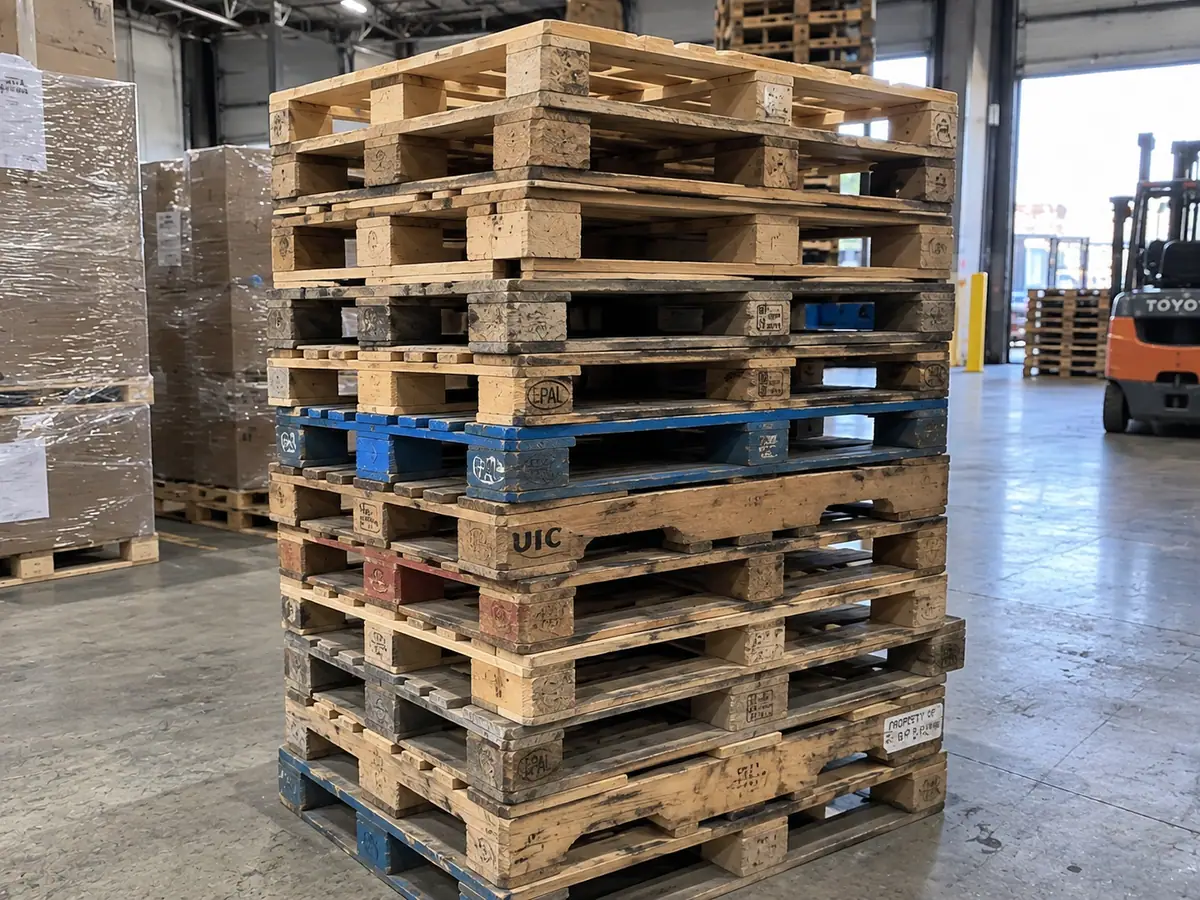
Price 42" × 42" stock
Give us the quantity, the size and the ZIP. You'll get a written quote with the grade, the freight and the pickup window — not a sales call.
- Written quotes, usually inside one business day
- Loads from 100 pallets to full 53' trailers
- We buy as readily as we sell — tell us which way it flows
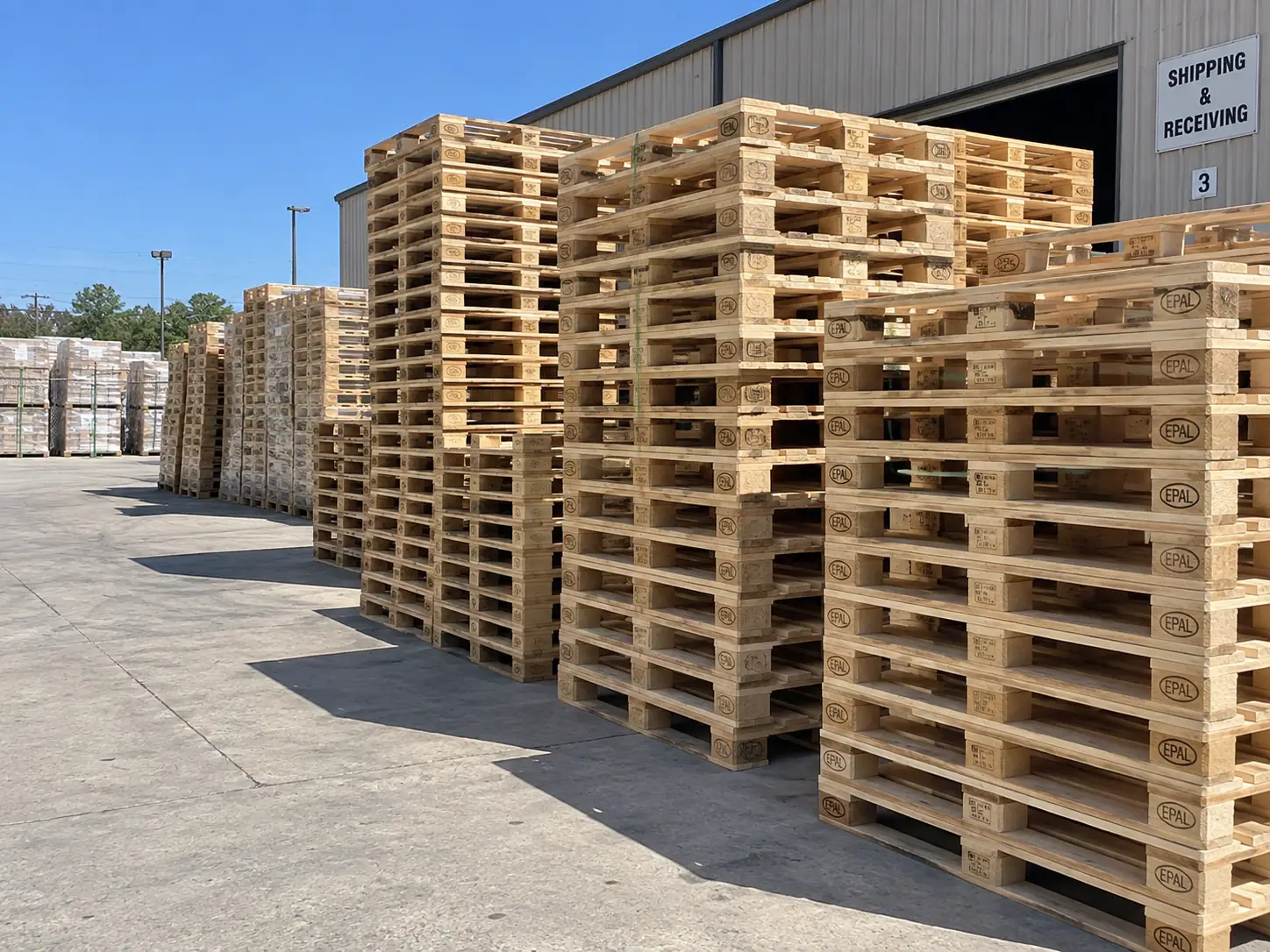
Outbound
Banded, counted and staged against the door. Stacks of fifteen, double-banded, the way a forklift expects them.
Drawn to scale
42" × 42" — 1067 × 1067 mm
6,000 lb
Static load
3,000 lb
Dynamic load
2,000 lb
Racked load
48 lb
Unit weight
5.5″
Overall height
6/3
Deck boards, top / bottom
42" × 42" · 6 top boards · 3 stringers
The square advantage
Why round product likes a square pallet.
Drums, pails and reels are round. Round product on a rectangular pallet always wastes a corner, and the waste is not symmetrical — you get overhang on one axis and dead space on the other.
A square footprint solves it. Four 55-gallon drums sit on a 42×42 with almost no overhang, and because the pallet is square, the load can be turned ninety degrees at any point in the process without anything changing. Conveyor lines, turntables and stretch wrappers all get simpler.
The cost is trailer efficiency: 42 inches does not divide neatly into a 98-inch trailer width the way 48 and 40 do. You lose a little cube, and you accept it because the alternative is losing product to overhang damage.
- Four 55-gallon drums fit with minimal overhang
- Orientation-independent on conveyors and turntables
- Common in paint, coatings, telecom cable and industrial chemicals
- Slightly less trailer-efficient than a 48×40
42 × 42 square
Questions
42 × 42 questions
Can I substitute a 48×40 for a 42×42?
Sometimes, and it is worth checking — the liquidity advantage of a GMA is real. But if your racking, conveyor guides or drum arrangement were designed around 42 inches, substituting will cause problems that cost more than the pallet saves.
How available is it used?
Less than a GMA, more than most. We hold Grade A and B and can usually supply within two to four days. Large one-off orders may take a week.
Does it rack differently?
The stringers run one way regardless of the square footprint, so it still has a strong axis and a weak one. Load it across the beams with the stringers spanning, exactly as you would a GMA.
Drum loading
What sits on a 42-inch square
| Load | Fit | Approx. weight | Clearance | Notes |
|---|---|---|---|---|
| Four 55-gal steel drums | 2 × 2 | ≈ 2,000 lb | Tight | The classic application; strapping is essential |
| Four 55-gal poly drums | 2 × 2 | ≈ 1,900 lb | Tight | Poly drums are slightly wider at the ribs |
| Four 30-gal drums | 2 × 2 | ≈ 1,100 lb | Comfortable | Room to strap and to handle |
| Nine 5-gal pails | 3 × 3 | ≈ 450 lb | Comfortable | Watch deck gaps under pail bases |
| Cable reels, single | Centred | 500 – 1,800 lb | — | Chock or the reel walks in transit |
| Paint, 5-gal, palletised | Layered | 1,400 – 2,200 lb | — | Tight deck gaps needed |
The trade-off
What a square footprint costs you in trailer cube
A 53-foot trailer is roughly 630 by 98 inches. Two 42-inch pallets side by side is 84 inches, leaving 14 inches of unused width — about 14% of the deck, on every load, forever.
By comparison a 48×40 loaded turned gives 96 inches across and wastes two. That difference compounds across every trailer you ever ship.
So the honest framing is that 42×42 buys you orientation-independence and a clean four-drum fit, and charges you meaningful trailer efficiency for it. For drum operations that is a good trade. For general freight it is not, and if you inherited this footprint without a drum reason, it is worth asking whether you still need it.
Questions
More 42 × 42 questions
Is 42×42 the same as the ISO 1067×1067 pallet?
Dimensionally, effectively yes — 42 inches is 1066.8 mm. ISO 6780 recognises 1067 × 1067 as one of its six footprints, which makes this one of the few American sizes with an international standing.
Does the square shape make it stronger?
No. The stringers still run one way, so it still has a strong axis and a weak one. Load it across the beams with the stringers spanning, exactly as you would a GMA.
How available is recycled 42×42?
Less than GMA, more than most specialty sizes. We hold Grade A and B and can usually supply within two to four days; large single orders may take a week.
Should we switch to 48×48 for drums?
If you rack drums, probably. The 48×48 carries a heavier deck as standard and gives room to strap. If you are floor-stacking and trailer cube matters, 42×42 stays the better answer.
Trailer maths
How many of these fit where.
53′ dry van
30
on the floor
≈ 60 stacked two high
48′ dry van
26
on the floor
≈ 52 stacked two high
40′ container
22
on the floor
≈ 44 stacked two high
20′ container
10
on the floor
≈ 20 stacked two high
Questions
42" × 42" pallets, answered.
What are the exact dimensions of a 42" × 42" pallet?
42" × 42" (1067 × 1067 mm), standing about 5.5″ tall. A recycled unit weighs roughly 48 lb, built on 3 stringers with 6 top and 3 bottom deck boards.
How much weight can a 42" × 42" pallet carry?
Around 6,000 lb static, 3,000 lb dynamic and 2,000 lb racked. Racked capacity is the number that matters if the pallet is going into beam storage unsupported, and it is always the lowest of the three.
What is a 42" × 42" pallet typically used for?
Telecom, paint, 55-gallon drums. The square footprint means it loads the same way whichever end faces the forks — handy for round product that will not stack square.
Do you stock 42" × 42" in recycled as well as new?
Yes. We hold graded recycled stock in this footprint and build new to order when the specification calls for it. Recycled Grade A typically runs about half the price of new — see pallet grades for what the letters mean before you order.
Can you deliver 42" × 42" pallets outside Ohio?
Yes. We run our own trailers across Ohio and the neighbouring states and use contract freight beyond that. Because freight is the largest variable in the delivered price, we quote delivered rather than FOB — see our service area.