Not in the main menu · reporting
99.4% diverted. Here is exactly how we know, and what the other 0.6% is.
Request a diversion statement
Existing customers can request historical statements for any period. New enquiries: tell us your volume and we will show you a sample.
- Written quotes, usually inside one business day
- Loads from 100 pallets to full 53' trailers
- We buy as readily as we sell — tell us which way it flows
Segregation
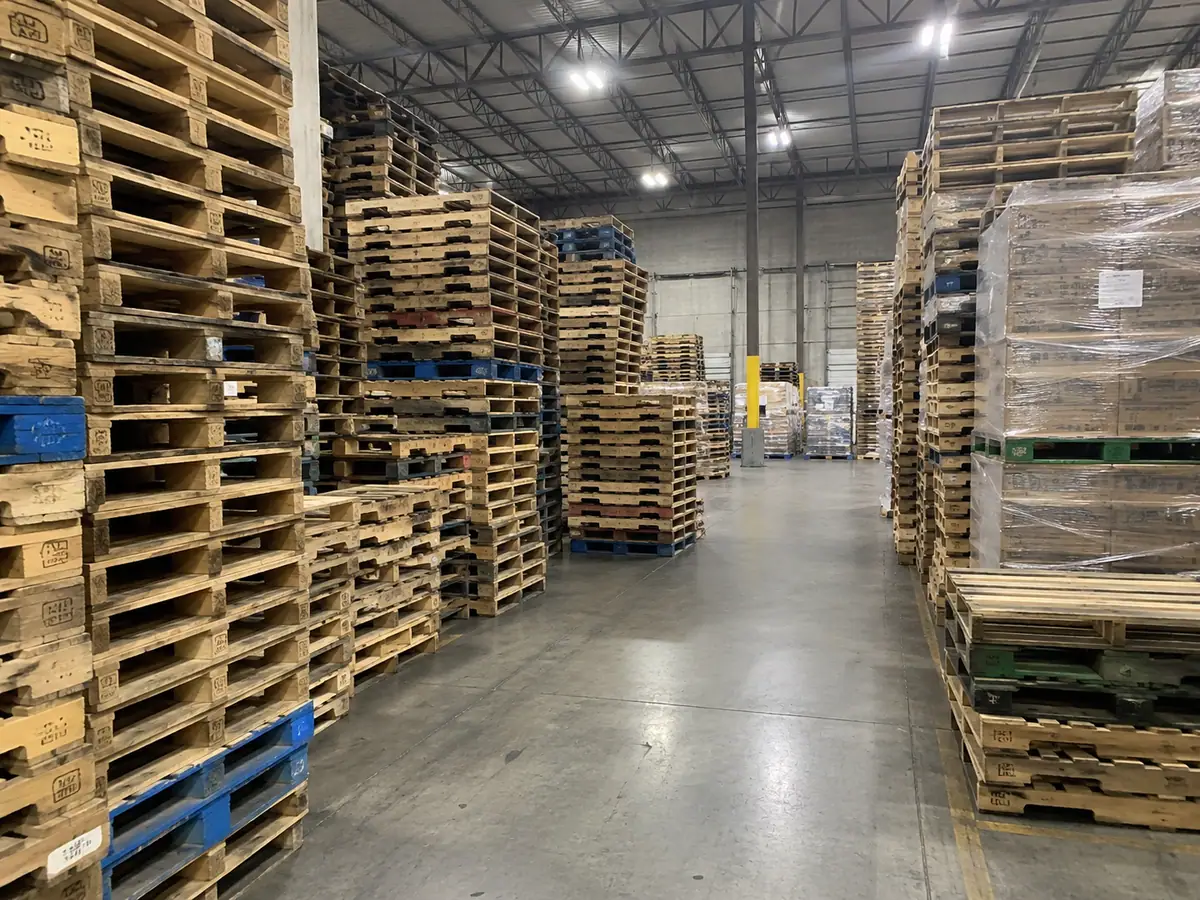
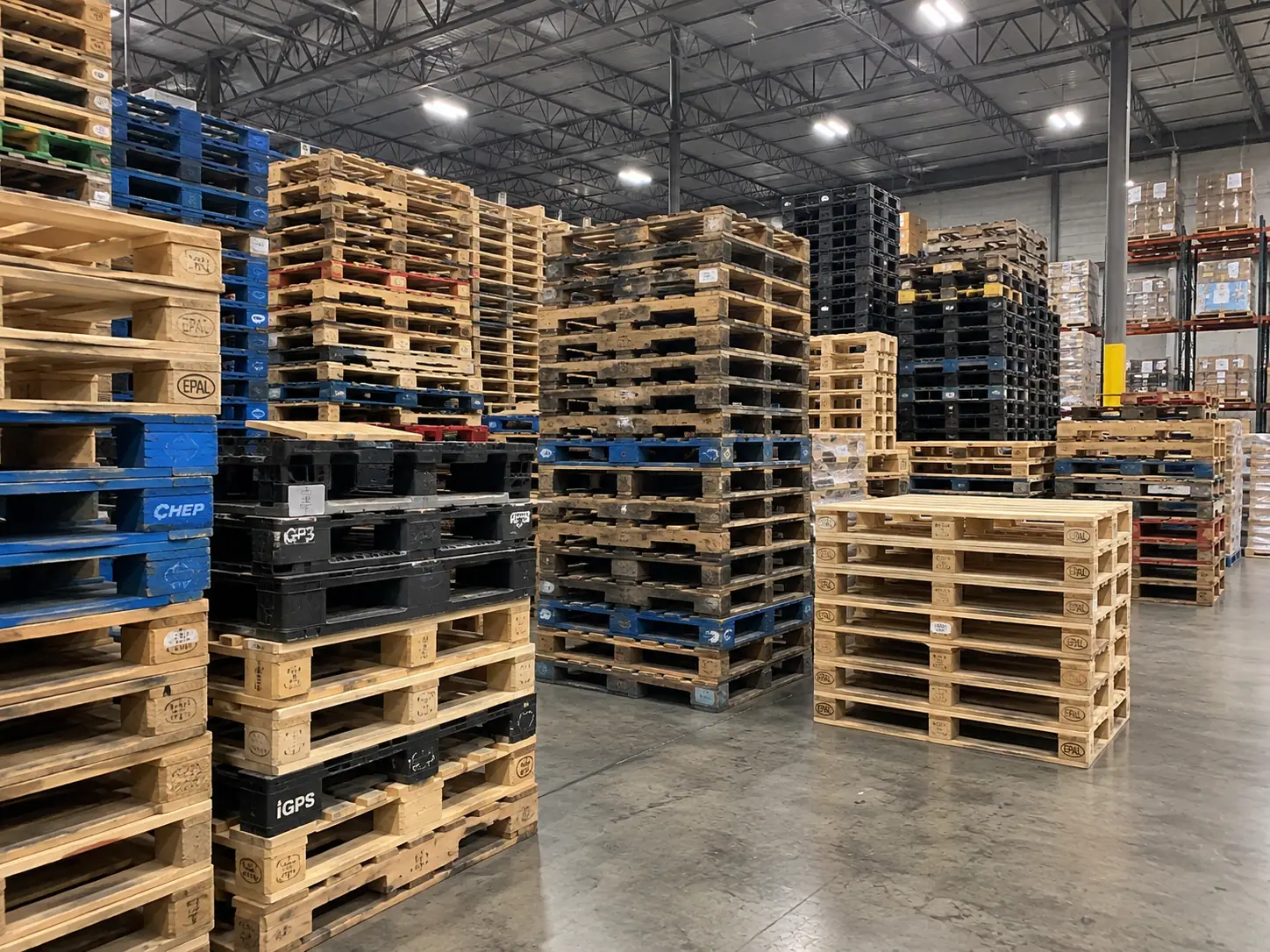
Sorted by type, not by convenience. Pooled units go back to the pool; plastic runs a separate stream entirely.
99.4%
Diverted by weight
2025 intake, Columbus yard.
0.6%
Landfilled
Treated and contaminated wood only.
10,500 t
Ground to fibre
Mulch, bedding and boiler fuel.
175 t
Ferrous recovered
Nails and banding to scrap.
Every one of these figures traces back to the truck scale described below. Nothing here is modelled — that is the carbon methodology page, which is a different kind of claim and is labelled as such.
How it is measured
Weights, not counts
Almost every diversion claim in this industry is built on counts — units in, units out — and counts are the wrong unit. A count cannot tell you what happened to a pallet that was dismantled, or how much of a load became fibre rather than a pallet. Weight can.
So the measurement starts at the truck scale. Gross in, tare out, difference recorded against the load. On the outbound side every stream is weighed: graded pallets, recovered lumber sold on, mulch by the cubic yard converted at a measured bulk density, bedding, boiler fibre, ferrous scrap, and disposal.
Monthly, those two totals are reconciled. They never match exactly — moisture loss alone accounts for a percentage point in a dry month — and the reconciliation notes the variance rather than hiding it. That variance figure is the single most useful thing an auditor can look at, because a process that reports no variance is a process that is not measuring.
2025 outcomes
Every stream, by weight
| Outcome | Share of intake | Destination |
|---|---|---|
| Reused as-is | 34.1% | Graded stock, back into distribution |
| Repaired and reused | 23.8% | Grade A and B recycled sales |
| Recovered lumber | 27.2% | Repair stock, remanufactured units, crates |
| Landscape mulch, natural and dyed | 9.0% | Landscape suppliers, municipal contracts |
| Animal bedding | 2.9% | Agricultural buyers |
| Boiler fibre | 2.0% | Industrial biomass boilers |
| Ferrous scrap | 0.4% | Scrap metal processors |
| Landfilled | 0.6% | Permitted disposal — treated and contaminated only |
The 0.6%
What we cannot divert, and why we print it.
Four categories account for essentially all of it: methyl-bromide-treated wood, pressure-treated and painted lumber, units contaminated with chemical or biological material, and composite products whose non-wood binders we cannot separate.
None of that belongs in a mulch stream that ends up on a school playground or a vegetable bed. Grinding it would raise our diversion figure and lower the quality of every product we make, which is a trade we are not willing to make.
It would also be easy to omit. A company that handles this material and reports 100% diversion is either quietly refusing difficult loads, or counting energy recovery as diversion, or not counting at all. When you see that number, ask which.
- Methyl bromide (MB-stamped) treated wood
- Pressure-treated, painted or stained lumber
- Chemically or biologically contaminated units
- Composites with inseparable non-wood binders
Evidence
What you get, and what an auditor will accept
- 01Weight ticket per collectionGross, tare and net for every inbound load, signed at the point of collection. This is the primary record and everything else derives from it.
- 02Monthly diversion statementTonnage received, tonnage by outcome, landfill tonnage, and the reconciliation variance. Issued to every collection customer, not just programme customers.
- 03Disposal documentationFor anything routed to permitted disposal, the facility and the tonnage. Small numbers, but the ones an auditor will look at first.
- 04Per-load Pallet PassportFor programme customers, a per-shipment record tracing to the underlying scale tickets. See Pallet Passport.
- 05A yard visitWe will walk your auditor around the site and show them the scale, the sort deck and the segregation area. Nothing on this page is a secret.
Questions
Diversion questions
Is energy recovery counted as diversion?
We count boiler fibre as a product because it displaces another fuel, and we state it separately at 2.0% so you can exclude it if your reporting framework requires that. Several do, and we would rather you could make that adjustment than have it buried.
Does this figure cover our specific pallets?
The 99.4% is a yard-wide average across all intake. Your specific load may differ — a trailer of clean cores diverts at effectively 100%, a trailer of wet broken units diverts almost entirely to fibre. The Passport gives the per-load picture.
Can we use this in a GRI 306 disclosure?
Yes, using your own weight tickets and monthly statements rather than the yard average. That is the level of evidence the standard actually asks for. See the recycling program guide.
Why not just refuse contaminated material?
Because it would move the problem rather than solve it, and it would push that material toward operators with less scruple about what goes into a mulch pile. We would rather handle it properly and report it honestly.
How do you identify treated wood before it reaches the grinder?
By stamp and by eye at the sort deck. IPPC marks carry the treatment code, so an MB stamp is segregated on sight, and pressure-treated, painted and stained lumber is pulled at the same station. Anything ambiguous goes to the segregation area rather than into the fibre stream.
The rule we work to is that doubt disqualifies. A unit we cannot confidently clear is weighed into the 0.6% and routed to permitted disposal, which is one reason that number is not smaller than it is.
Ask us for the statement before you need it.
If your reporting cycle is coming up, tell us the period and the format your team uses. We would rather build it now than under deadline.