Operations guide · 10 min read
A practical guide to pallet recycling for operations managers.
Last reviewed January 2026 · Written by the RePallet USA yard team
Ask us about anything on this page
These guides are written by the people who grade the pallets. If something here does not match your situation, tell us in the message field.
- Written quotes, usually inside one business day
- Loads from 100 pallets to full 53' trailers
- We buy as readily as we sell — tell us which way it flows
The last four per cent
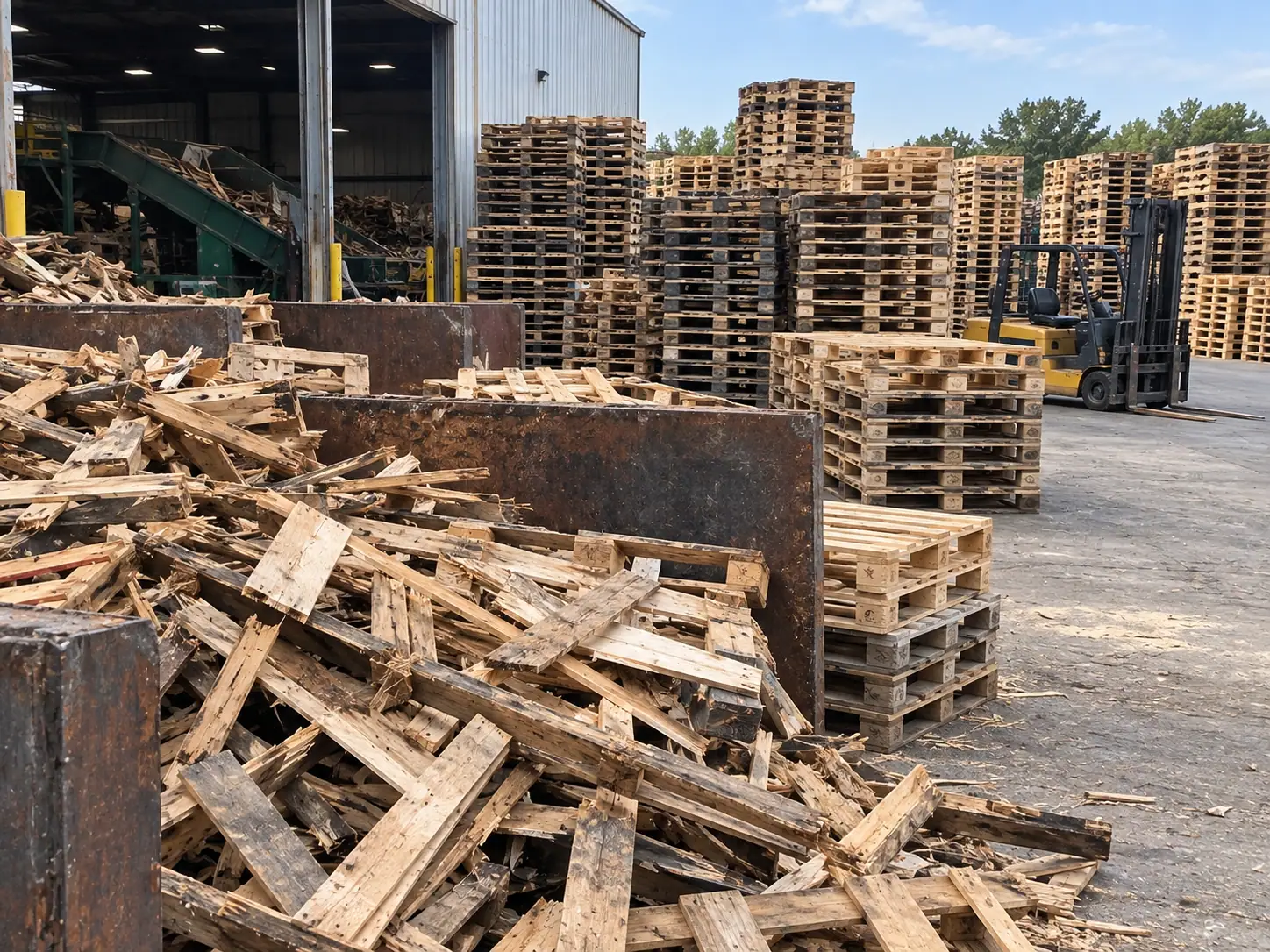
Everything the sort deck rejected, on its way to the grinder. It leaves as mulch, bedding and boiler fibre — not as landfill.
Setting it up
Four weeks to a working program.
- Step 01
Week one: measure
Count what leaves and what accumulates. Photograph a typical stack. Pull twelve months of invoices for pallet purchases and waste removal — they are usually in different systems and nobody has added them together.
This step alone often finds the answer.
- Step 02
Week two: separate the streams
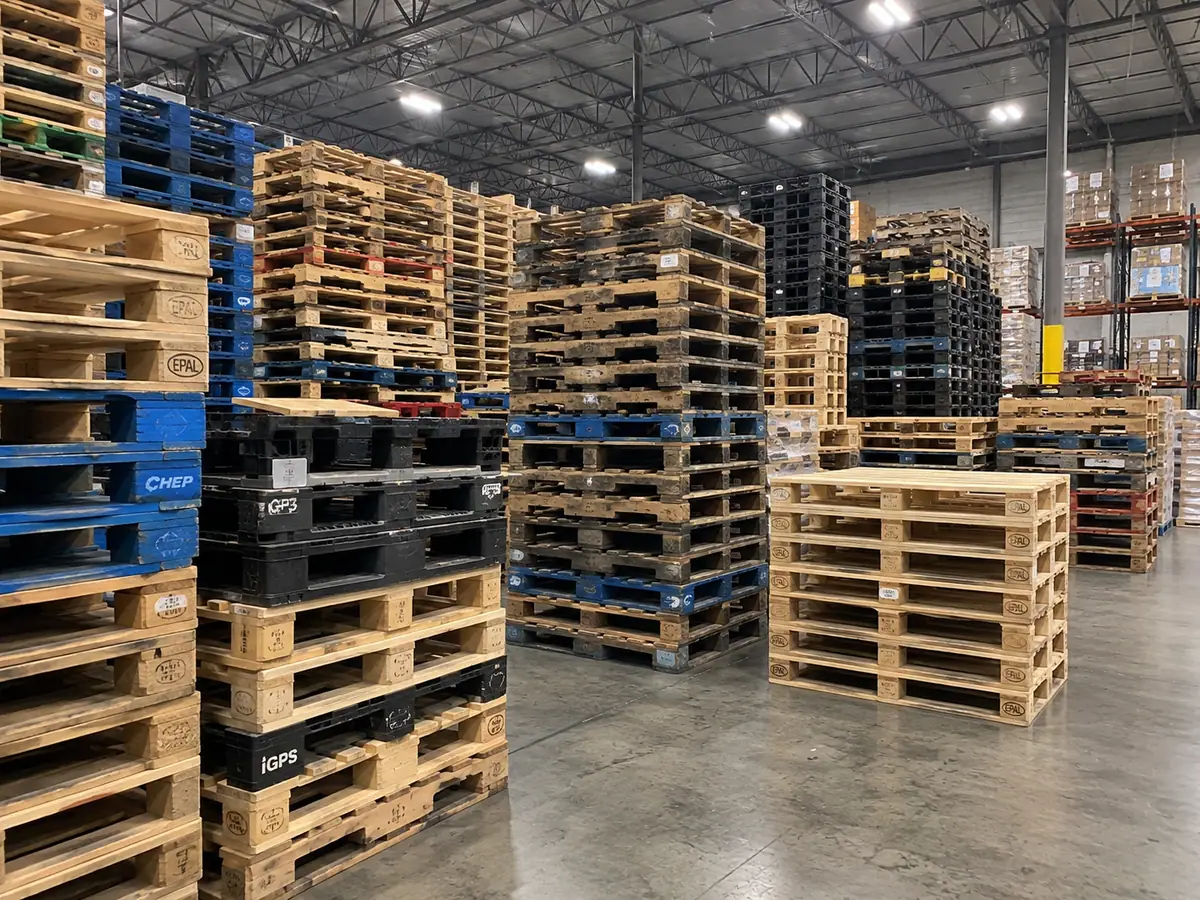
Whole 48×40 cores in one place, odd sizes in another, broken units in a third. Physically, with a painted line if necessary. Mixed piles are worth substantially less than the sum of their parts.
Sorting is the highest-return activity available.
- Step 03
Week three: get quotes
Ask for pricing per stream, in writing, with grade definitions attached. A quote that gives one number for 'pallets' is not comparable with anything.
Ask what happens if a load does not match.
- Step 04
Week four: contract and instrument
Fixed pickup slot, signed count ticket per collection, weight ticket, monthly diversion statement. Put the reporting requirement in the agreement, not in an email.
Reporting added later is reporting you will argue about.
Deciding per stream
Sale or removal?
| Stream | Typical outcome | Indicative economics |
|---|---|---|
| Whole 48×40 cores | Sale | You receive $4.00 – $6.00 per unit |
| Repairable 48×40 | Sale | You receive $2.25 – $4.00 per unit |
| Whole odd sizes | Sale | You receive $0.75 – $3.00 per unit |
| Broken and mixed | Removal | You pay $95 – $180 per trailer |
| Wet or mouldy | Removal | You pay, and it is worth fixing the storage |
| Branded / pooled | Return to pool | Not yours to sell |
| Contaminated | Permitted disposal | Quoted case by case |
Reporting
What an auditor will actually ask for.
The claim 'we recycle our pallets' is not evidence. Under GRI 306 or a corporate zero-waste target, an auditor wants to see tonnage: how much material left your site, where it went, and what happened to it.
That means weight tickets per collection — not counts, weights — and a periodic statement from the processor reconciling tonnage received against tonnage by outcome. If your vendor cannot produce that, your diversion figure is an assertion.
It is worth asking one further question: what proportion goes to landfill? A vendor claiming 100% diversion is either not handling difficult material or is not being straight with you. Ours is 0.6% and we publish it.
- Weight ticket per collection, not just a count
- Monthly statement: tonnage in, tonnage by outcome
- A stated landfill percentage — and scepticism if it is zero
- Documentation for anything sent to permitted disposal
- A named contact who can walk an auditor through it
Watch for
Four things that quietly wreck a program
- 01The streams merge againThree months in, someone puts broken units on the good stack because it was closer. Paint lines, signage and a five-minute briefing at shift change prevent it.
- 02Storage goes outdoorsSpace gets tight, stacks move outside, and the value of the stream halves within a season. This is the most expensive silent failure in the list.
- 03Nobody owns itPallet programs fall between shipping, facilities and procurement. Name one owner or it will drift.
- 04Reporting stops being checkedThe statements keep arriving and nobody reads them. Set a quarterly review — it is fifteen minutes and it is where discrepancies surface.
Questions
Program questions
Should we sort in-house or pay someone to?
In-house, if you have the labour and the space. The value uplift from sorting typically exceeds the cost of the labour by a wide margin. If you genuinely do not have the space, a mixed-load arrangement is honest and we will price it accordingly.
What volume justifies a formal program?
Around a trailer of empties a fortnight, or 1,500 units a month in either direction. Below that, transactional is fine and simpler.
Can one vendor handle both supply and collection?
Yes, and it is usually cheaper because the same truck does both. See managed pallet programs.
How do we handle pooled pallets in the stream?
Segregate and return them. Selling them is not an option, and a good vendor will pull them out for you rather than quietly reselling them.
Our empties are stacked outside. How much is that actually costing us?
Usually more than the indoor space would have cost. Wood above roughly 19% moisture drops a grade, and a stack left in the open through a season moves from the sale column to the removal column — from receiving $4.00 to $6.00 a unit to paying $95 to $180 a trailer to have it taken away. A roof and some dunnage typically pays for itself inside one season's stream.
Send us twelve months of invoices.
We will build the real number — purchases plus removals plus freight — free, whether or not you go any further with us.