Standards guide · 8 min read
Pallet grades explained: why nobody agrees on what Grade A means.
Last reviewed January 2026 · Written by the RePallet USA yard team
Ask us about anything on this page
These guides are written by the people who grade the pallets. If something here does not match your situation, tell us in the message field.
- Written quotes, usually inside one business day
- Loads from 100 pallets to full 53' trailers
- We buy as readily as we sell — tell us which way it flows
Inside the building
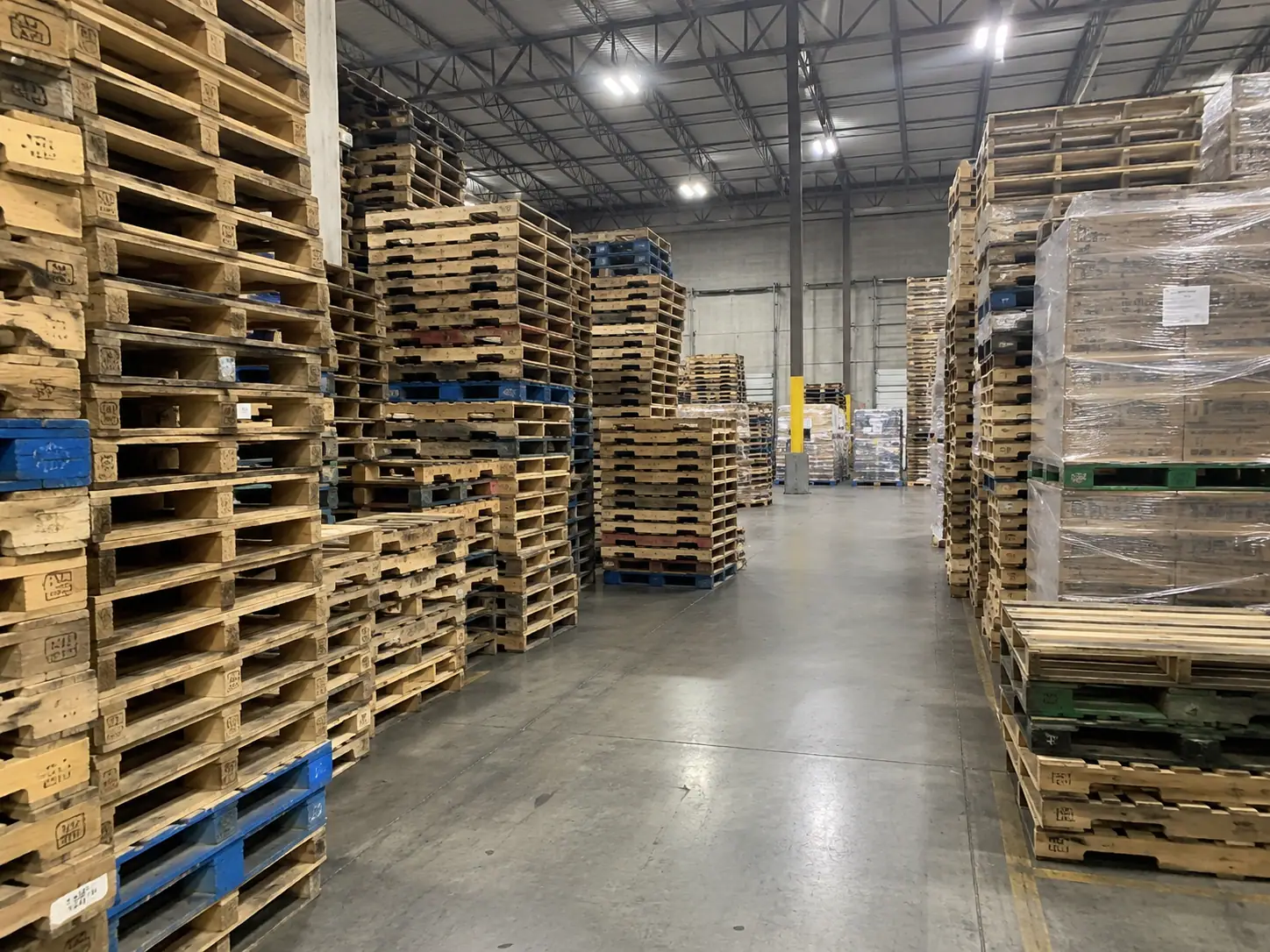
The sort aisle at half past seven. Graded stock on the left, waiting to be worked on the right.
Where the words came from
A vocabulary that grew out of trading, not standards-setting
Pallet grading vocabulary developed the way most trading vocabulary does: informally, between people who could see the goods. When a yard buys from a yard, both parties are looking at the same stack, and 'Grade A' is shorthand for a shared judgement rather than a specification.
That works fine between people in the same trade. It works badly when a manufacturer three states away buys on the phone, because now the shorthand is carrying weight it was never designed for.
Various industry bodies publish guidance and several large buyers have written their own specifications, but none of it is binding on anyone. The word means what the seller says it means.
Common definitions
What most yards mean, most of the time
| Term | Usual meaning | Where suppliers differ |
|---|---|---|
| Grade A / #1 | All members present, full length | Whether a repaired stringer is permitted |
| Grade B / #2 | Up to 2 replaced deck boards | Whether plugs and multiple repairs count |
| A/B mix | Unsorted blend of both | The ratio, which is rarely stated |
| Premium A / A+ | Grade A plus appearance sort | How strict the appearance criteria are |
| Remanufactured | Rebuilt from recovered lumber | Deck board count, often 5 rather than 7 |
| Core | Unsorted incoming stock | Whether broken units are included |
| Economy | Usually Grade B or below | Almost entirely undefined |
Making quotes comparable
Five questions that turn a price into information
- 01Does your Grade A permit a repaired stringer?The single most informative question in the trade. There is no wrong answer — plenty of good yards allow it — but it typically accounts for the largest single price gap between two 'Grade A' quotes.
- 02What is your moisture threshold at dispatch?Under 19% is the usual answer. A supplier who has not thought about it is not checking, and wet stock will cost you a load.
- 03Are replacement deck boards full length?Spliced or short boards across a break are a different product from a full-member replacement, and they behave differently under a concentrated load.
- 04What is your squareness tolerance?A quarter inch is tight, half an inch is normal, and no answer means nobody is checking. Out-of-square pallets are what jam racking.
- 05What happens if a load does not match?The answer tells you how confident they are. A supplier who replaces without argument is grading to a standard; one who wants photographs, notarised statements and a site visit is not.
Our position
Why we publish ours
We grade at the strict end. No stringer repairs in Grade A, full-length replacement boards only, squareness within a quarter inch, moisture under 19% verified at three points. The full criteria are on the Grade A specification sheet, which is the actual document our sort deck works from.
That costs us: it means a proportion of stock other yards would sell as A, we sell as B at a lower price. We do it because the alternative — a definition that flexes when a load is tight — is a definition that means nothing, and because racked loads are exactly where a repaired stringer gets tested.
We also publish our internal audit result: about 2% of outbound stock is re-checked and roughly one unit in six hundred is found mis-graded. That number is not zero and pretending it is would be nonsense.
Questions
Grading questions
Is there an official standard?
No. There is guidance, there are large buyers' specifications, and there is convention — but no certifying authority and no legal definition.
Which grade do I need?
If it racks, touches food or goes through automation, Grade A. If it leaves once and never returns, Grade B. Full logic in Grade A vs Grade B.
Can a repaired pallet be Grade A?
In our system, yes if the repair was a full-length deck board, no if it involved a stringer. Other yards differ, which is exactly the point of this article.
How do I verify a load?
Pull ten units at random from different stacks and check them against the written criteria. If a supplier objects to that, you have learned something valuable.
What does remanufactured actually mean?
A unit rebuilt from recovered lumber rather than repaired — sound components from several pallets combined into one. It is cheaper than Grade A and perfectly serviceable for one-way outbound, but the deck board count is frequently five rather than seven, which changes how it behaves under a concentrated load. Ask for the board count and whether the boards are full length before you compare the price with anything else.
Ask us the stringer question.
The answer is no — our Grade A does not permit a repaired stringer. Now go and ask everyone else quoting you.