Comparison · 9 min read
Wood vs plastic pallets: the loop decides it.
Last reviewed January 2026 · Written by the RePallet USA yard team
Ask us about anything on this page
These guides are written by the people who grade the pallets. If something here does not match your situation, tell us in the message field.
- Written quotes, usually inside one business day
- Loads from 100 pallets to full 53' trailers
- We buy as readily as we sell — tell us which way it flows
Inside the building
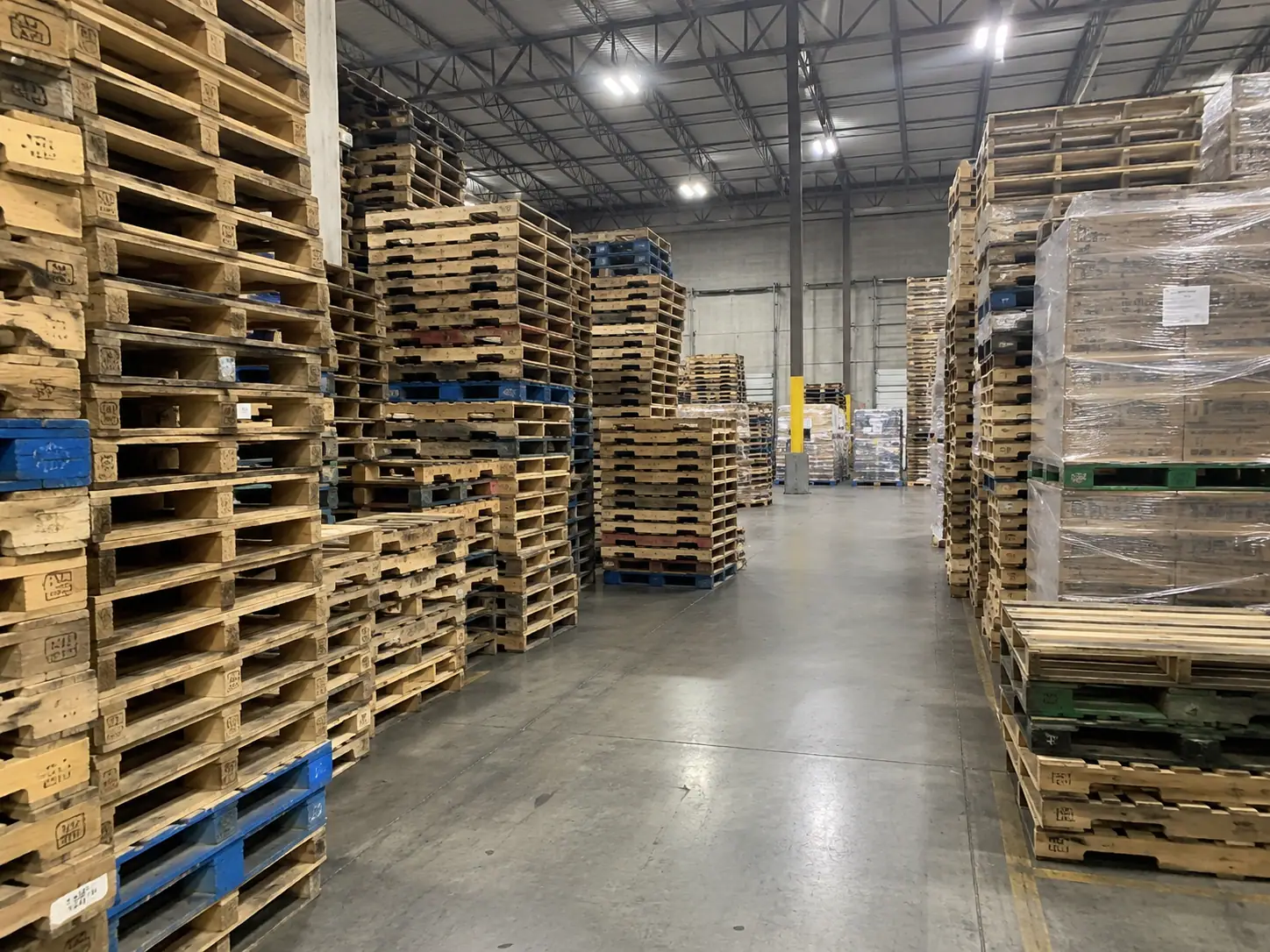
The sort aisle at half past seven. Graded stock on the left, waiting to be worked on the right.
The arithmetic
Cost per cycle, and the assumption hiding inside it
A $60 plastic pallet that completes 80 internal cycles costs $0.75 per cycle. A $9 recycled wood pallet that completes six costs $1.50. On those numbers plastic is twice as cheap and the decision looks obvious.
Now assume a 4% loss rate per cycle — pallets that leave and do not come back, get damaged beyond use, or simply disappear. At 4% per cycle, the expected life of any pallet is about 25 cycles regardless of how durable it is, because it will be lost long before it wears out. The plastic pallet now costs $2.40 per cycle and the wood one still costs $1.50.
This is why the honest question is never 'which pallet lasts longer'. It is 'what is your loss rate', and most operations have never measured it.
Head to head
Wood against plastic, 48 × 40
| Recycled wood | New wood | Plastic HDPE | |
|---|---|---|---|
| Purchase price | $7.50 – $12.00 | $17 – $22 | $45 – $120 |
| Weight | 45 – 55 lb | 35 – 60 lb | 15 – 45 lb |
| Service life, protected loop | 5 – 8 cycles | 10 – 25 cycles | 50 – 100+ cycles |
| Repairable | Yes, $1.75 – $3.50 | Yes | Rarely, uneconomic |
| Wash-down | No | No | Yes |
| ISPM-15 | Treatment required | Treatment required | Exempt |
| Fire code (idle storage) | Restricted | Restricted | More restricted |
| Embodied CO₂e | ≈ 1.2 kg | ≈ 15 – 17 kg | ≈ 90 – 130 kg |
| End of life | Mulch, fibre, energy | Mulch, fibre, energy | Regrind if resin is clean |
Where plastic clearly wins
Three genuine cases
- 01Wash-down and high-care food zonesWhere the hazard analysis requires a cleanable, non-porous surface, wood cannot compete and should not try. See food and beverage.
- 02Frequent international exportPlastic is outside ISPM-15 entirely. On a high-frequency export lane, the avoided treatment cost and avoided hold risk can justify the price on its own.
- 03Genuinely closed internal loopsPlant-to-plant movement with controlled returns and a measured loss rate under about 1% per cycle. This is the case where the durability argument actually pays.
The one people forget
Fire code treats them very differently.
Idle pallet storage is specifically addressed in NFPA 13 and most adopted local codes, and plastic is treated far more restrictively than wood — lower permitted stack heights, greater separation distances and heavier sprinkler requirements.
For an operation storing a few hundred empties this is academic. For anyone planning to hold a large returnable fleet on site, it is a design constraint that should be checked with a fire protection engineer before the purchase order, not after.
It has caught out more than one operation that switched fleets for hygiene reasons and then discovered their storage area no longer complied.
- Idle plastic pallet storage carries lower stack limits than wood
- Sprinkler design requirements differ substantially
- Check before committing to a large on-site fleet
Questions
Wood vs plastic questions
Are plastic pallets more sustainable?
Only in a genuine closed loop with many cycles. The embodied carbon of an HDPE pallet is roughly 90 to 130 kg CO₂e against 1.2 kg for a recycled wood unit, so it needs a great many cycles to break even. In one-way use it is dramatically worse.
Can plastic pallets be recycled?
If the resin is clean and separable, yes, into regrind. Contaminated or mixed-resin units frequently are not. We take plastic back on collection runs and route it to a resin recycler rather than into our wood stream.
Do plastic pallets rack as well?
Rackable plastic units, usually steel-reinforced, do. Nestable plastic units emphatically do not, and confusing the two is a known cause of rack failures.
What about hybrid or composite pallets?
They exist and some perform well, but they are difficult to recycle at end of life because the materials cannot be separated. That is a real cost that rarely appears in the sales comparison.
Does fire code really limit how many plastic pallets I can store?
Yes, and more tightly than it limits wood. NFPA 13 and most adopted local codes treat idle plastic pallet storage as the higher hazard: lower permitted stack heights, greater separation distances and heavier sprinkler design requirements. For a few hundred empties it is academic, but before you commit to holding a large returnable fleet on site, put the question to a fire protection engineer — after the purchase order is an expensive time to find out.
Measure your loss rate first.
Count what goes out and what comes back over one month. That single number decides this question more than any spec sheet.