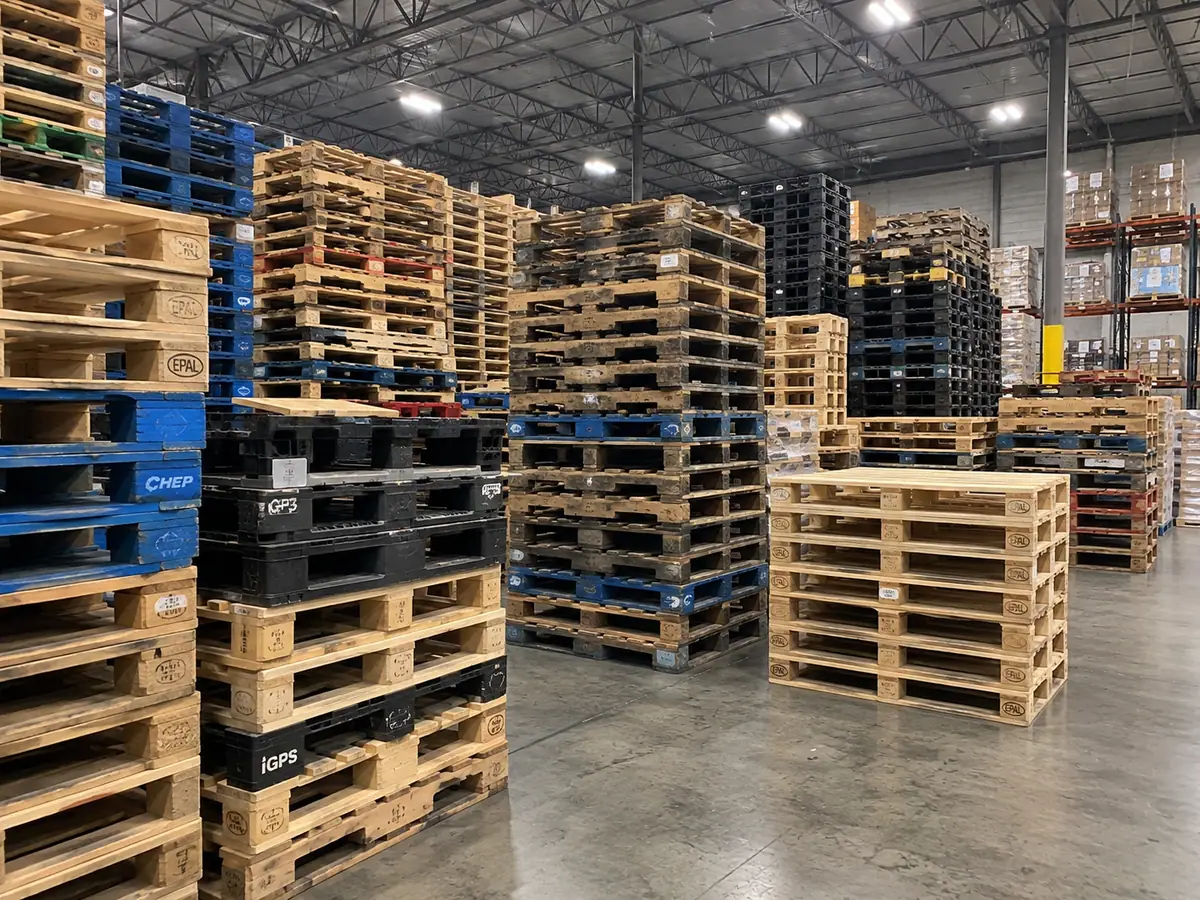
A stringer pallet's three long boards carry the load. Cutting a nine-inch notch out of the underside of two of them, to let forks in from the sides, removes material from a beam in the region where beams are working hardest.
Structurally it is a compromise. Operationally it is the reason the North American pallet works at all.
What the notch costs
The bending stiffness of a rectangular section is proportional to its width times the cube of its depth. Cutting an inch and a half out of a three-and-a-half-inch stringer leaves two inches of depth in that region.
Two cubed is eight; three and a half cubed is about forty-three. So the notched section has roughly nineteen per cent of the bending stiffness of the full section.
The notch is positioned away from mid-span, where bending moment is lower, which mitigates it considerably. But it is still a substantial local weakening and it is why notch damage is the pallet failure most likely to become a catastrophic one.
| Section | Depth | Relative bending stiffness | Where |
|---|---|---|---|
| Full stringer | 3½″ | 1.00 | Mid-span, where moment is highest |
| Notched section | 2″ | 0.19 | Under the fork opening |
| Heavy stringer | 3¾″ | 1.23 | Mid-span, heavy builds |
| Light stringer | 3″ | 0.63 | Mid-span, economy builds |
Why we do it anyway
Because the alternative is a two-way pallet, and a two-way pallet in a real warehouse is a permanent nuisance. Forklift approach angles are determined by aisle geometry, not by preference, and a driver who has to reposition to enter from the correct side is a driver losing thirty seconds every lift.
Multiply that across a shift and the structural argument stops mattering. The notch is a real weakening and it buys back far more in handling time than it costs in capacity.
This is one of the more honest engineering trade-offs in logistics, and it is invisible to almost everybody who uses the product.
The block alternative
European block pallets solve it differently: nine blocks and three bottom runners, with no continuous stringers to notch. Entry from all four sides is genuinely equivalent, and nothing is cut out of a load-bearing member.
The costs are build price, weight, and repairability — a cracked block is a substantially bigger job than a broken deck board, and the North American repair infrastructure is built entirely around stringers.
Where blocks are winning is anywhere that dimensional consistency matters, because blocks set the geometry rather than the sum of three variable board thicknesses. That is a different argument from the notch one, and it is the one actually driving adoption.
What to do about it
- Inspect notches specifically. A notch broken through to the bottom deck is a reject, not a repair candidate.
- If you rack heavy loads, ask about stringer depth. A quarter inch of extra depth is worth twenty-three per cent more bending stiffness, which is a bigger effect than most people assume.
- Watch fork approach angles. Notch damage is almost always a technique or sightline problem, and it clusters around specific operators and specific aisles.
- Consider blocks for automated handling. Not because of the notch, but because of the tolerance consistency that comes with machined components.