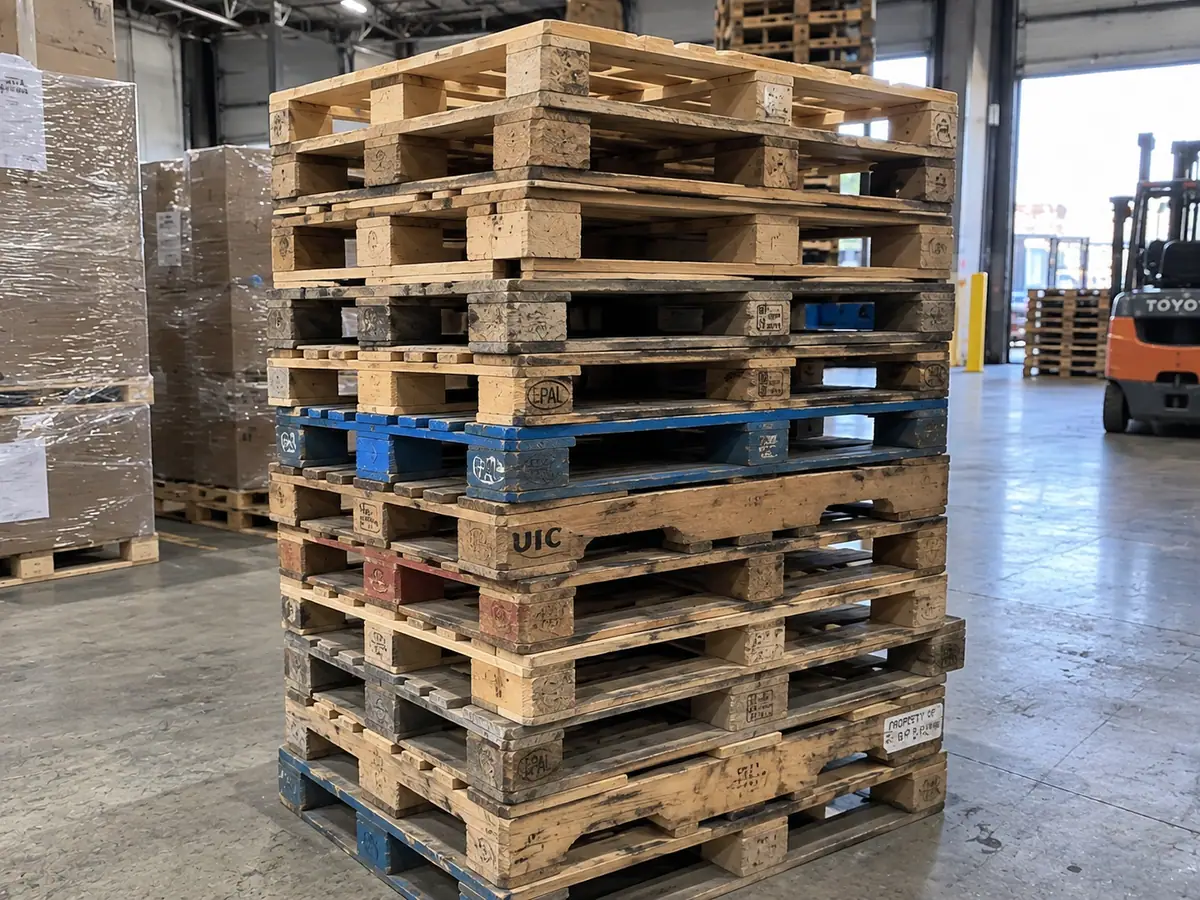
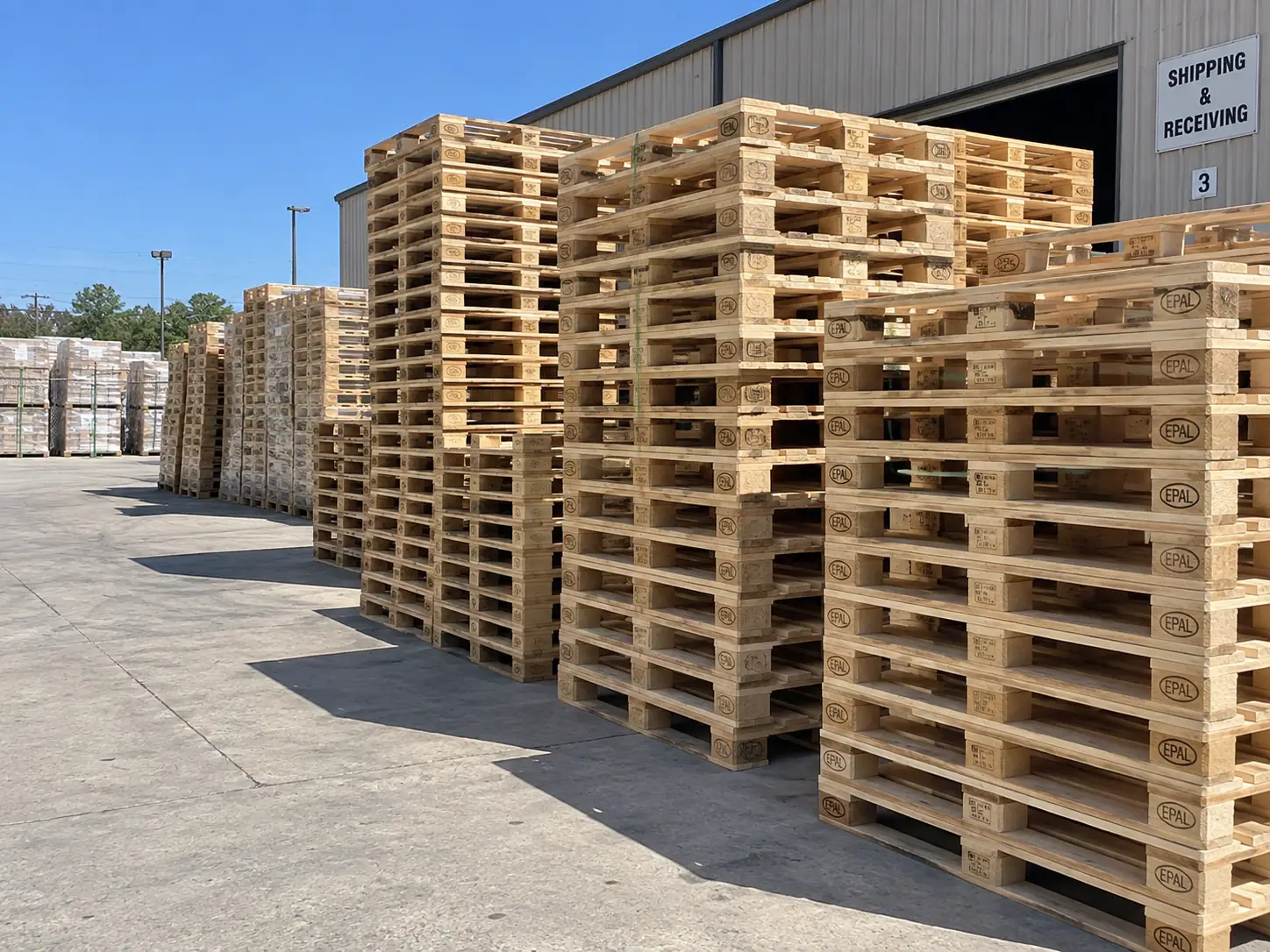
A 48×40 GMA pallet is twelve pieces of wood and somewhere between seventy-eight and ninety nails. That is the whole object.
It is also, in our experience, the thing customers know least about the product they buy in the largest quantity. So: every member, what it does, and which ones matter.
The three stringers
1⅜ inches thick, 3½ inches deep, 48 inches long, hardwood. Three of them, running the length of the pallet.
These are the load-bearing members and everything else on the pallet is attached to them. On a floor they transfer load down; in a rack they act as beams and carry it across a span, which is a completely different and much harder job.
Two of the three are notched — nine inches long, an inch and a half deep — to allow fork entry from the sides. That notch removes material from exactly the region where a beam wants depth, which is the compromise at the heart of the four-way stringer pallet.
Seven top deck boards
9/16 of an inch thick, between 3½ and 5½ inches wide, 40 inches long. The two outermost — the lead boards — are usually the widest, because they take the most abuse from forklift entry.
Their job is spreading the load across the stringers and stopping product falling between them. Deck gap matters here: much over 3½ inches and small cases start to drop through.
Thickness is the number to ask about. A 5/16-inch deck and a 9/16-inch deck are different products, and the price difference between them is most of the gap between a cheap new pallet and a good one.
Three bottom deck boards
Same thickness, usually wider. Their job is spreading the load onto whatever the pallet is sitting on, and in a rack that means the beams.
Bottom deck coverage — the proportion of the footprint they occupy — is one of the least-discussed numbers in pallet specification and one of the more important ones. Below about forty per cent, racked capacity falls sharply because beam contact area falls with it.
They are also what a pallet jack rides on, which is why the chamfer on their leading edges exists and why missing chamfers cause jack damage.
Seventy-eight to ninety nails
About four grams each, so roughly three-quarters of a pound of steel in a 45-pound pallet.
Fastener choice does more to determine service life than almost anything else. Helically threaded and stiff-stock nails rotate as they drive and grip hard; smooth shank nails do not, and a pallet whose fasteners loosen racks out of square, which puts uneven load on the members, which cracks them.
Staples appear on some imported and lightweight units and are the worst of both worlds: poor holding power and a tendency to shear off inside the wood where a magnet cannot recover them at end of life.
| Member | Count | Nominal size | Its job |
|---|---|---|---|
| Stringer | 3 | 1⅜″ × 3½″ × 48″ | Carries the load; acts as a beam in a rack |
| Top deck board | 7 | 9/16″ × 3½–5½″ × 40″ | Spreads load, supports product |
| Bottom deck board | 3 | 9/16″ × 5½″ × 40″ | Spreads load onto floor or beams |
| Fasteners | 78 – 90 | 2¼″ helical | Holds the geometry together |
And the wood itself
Mixed northern hardwood, in North American recycled stock: oak, maple, poplar, gum and ash, typically three or four species in a single unit.
Density gives you strength and nail retention, and density gives you weight. There is no species that provides one without the other, which makes the hardwood-versus-softwood choice a freight decision as much as a structural one.
Roughly half of the dry mass is carbon that came out of the atmosphere while a tree was standing. A 45-pound pallet is holding something like ten kilograms of it, which is the entire environmental argument for keeping the thing in service.